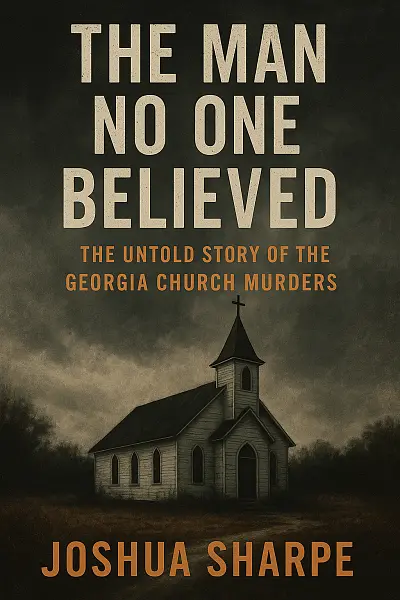
The Man No One Believed: The Untold Story of the Georgia Church Murders
by: Joshua Sharpe
Joshua Sharpe is an intrepid journalist from South Georgia who stumbles onto a cold case that has haunted his community: the 1985 church murders of Harold and Thelma Swain, beloved pillars of the area’s Black community. When a flawed investigation pins the crime on Dennis Perry, a seemingly ordinary local man, Sharpe can't shake the feeling that the real story lies buried.
Driven by his relentless curiosity and a deep sense of injustice, Sharpe picks at decades-old secrets, facing stonewalling authorities and personal danger. As he uncovers explosive new evidence, the question becomes: can truth finally win against a stubborn system desperate to save face?
"Truth does not falter because it is doubted; it endures because someone refuses to let it be buried."
Let's Break This Down
The Author's Voice
Atmosphere
Moody, unnerving, and steeped in Southern Gothic undertones. Sharpe conjures a palpable sense of unease, drawing you into the humid backroads of rural Georgia where secrets seep into every page. The tension builds quietly, like distant thunder before a storm—moments of dread are balanced with humanity, making the chilling crime scenes feel both real and hauntingly surreal.
Prose Style
Direct, evocative, and journalistic with a storyteller’s flair. Sharpe’s writing is clean and unadorned, yet he knows exactly when to drop in a vivid description or a sharply observed detail that sticks with you. Dialogue is captured with an ear for authenticity, and there's a lived-in quality to the way he sketches both characters and settings. His style never calls attention to itself, instead letting the drama of real-life events do the heavy lifting—think gritty reportage crossed with literary true crime.
Pacing
Measured but propulsive. The narrative unfolds methodically, peeling back layers bit by bit. Sharpe is in no hurry to rush past the small revelations or emotional turning points. This means there’s a steady, almost investigative rhythm—he takes the time to build context, set scenes, and spotlight personal stakes. Yet, when pivotal moments arrive, he accelerates the tempo, pulling readers straight into the heat of the action before returning to a slower simmer as the facts settle in.
Characterization
Empathetic and nuanced. Every figure, from the accused to the community members, is rendered with care—Sharpe resists easy villainization or saintly portraits. Instead, he presents their contradictions, vulnerabilities, and motivations with a reporter’s detachment yet a novelist’s sensitivity. Expect complex portrayals over caricatures, making it hard not to get tangled up in the fates of even the most minor characters.
Mood and Feel
Raw, intimate, and quietly suspenseful. The entire book buzzes with undercurrents of suspicion and sorrow, but also glimmers of hope and resilience. There’s a sense of place so strong you can almost smell the pine and feel the tension at every potluck and prayer meeting. Sharpe’s style ensures you’re not just witnessing a crime—you’re living in its aftermath alongside everyone touched by it.
Key Moments
-
Small-town whispers ignite as an outcast becomes the only suspect—chilling suspense from the very first chapter
-
Flashbacks reveal fractured faith and family secrets—each memory darker than the last
-
Courtroom scenes pulse with tension, exposing deep-seated biases and a broken justice system
-
Atmospheric prose that turns rural Georgia into a character—humid, haunting, unforgettable
-
Intimate interviews with locals peeling back layers of doubt, fear, and denial
-
Raw, emotional confrontations: grief collides with suspicion at every turn
-
That devastating final verdict—impossible to close the book without a racing heart
Plot Summary
The Man No One Believed: The Untold Story of the Georgia Church Murders by Joshua Sharpe follows the haunting true story of the 1985 double homicide at Rising Daughter Baptist Church in rural Georgia. When the elderly Alday couple—deacons deeply loved by their community—are found brutally murdered, suspicion quickly falls on a poor Black farmhand, Dennis Perry. As the story unfolds, initial investigations are colored by racial bias, shoddy police work, and community fear, spiraling into a wrongful conviction. Decades later, journalist Joshua Sharpe reopens the case, uncovering buried evidence, overlooked eyewitnesses, and startling DNA revelations. The book climaxes with Perry’s conviction unraveling in court, and the bittersweet aftermath leaves readers grappling with justice, truth, and the scars of a community forever changed.
Character Analysis
- Dennis Perry is depicted as a quiet outsider who dreams of a better life but is ensnared by prejudice and systemic injustice; his journey from hopeful laborer to wrongfully convicted man is both heartbreaking and revealing, showing resilience and despair.
- Joshua Sharpe, acting as both investigator and narrator, evolves from curious reporter to determined advocate, risking personal safety to expose the truth; his empathy and drive embody a search for justice beyond headlines.
- Supporting figures like Sheriff Deal and witness Joy Wilkes add complexity: Deal’s intentions seem tangled in the era's social expectations, while Joy wrestles with the pain of memory, honesty, and community loyalty.
- All characters are shaped by their motivations—fear, loyalty, or truth-seeking—resulting in arcs colored by both individual choices and the collective failings of the justice system.
Major Themes
- Justice versus Injustice runs through every page, exposing both the fallibility of American law enforcement and the human cost of getting it wrong; the wrongful conviction of Perry is the most glaring example.
- Race and Prejudice are constant undercurrents, as the investigation and trial are deeply influenced by the rural South’s fraught racial history, seen in the town’s quickness to judge Perry based on his background.
- The power of truth-seeking journalism is another vital theme; Sharpe’s relentless pursuit not only uncovers facts but also challenges the comfortable narratives held by authority and community alike.
- Memory and Community: Eyewitness accounts and changing community loyalties reveal how personal remembrance and collective identity collide in the pursuit of justice.
Literary Techniques & Style
- Sharpe writes with immersive, journalistic prose that blends the pacing of a true crime thriller with the depth of investigative nonfiction.
- The narrative unfolds in a nonlinear fashion, weaving between past and present to create suspense and allow for deep dives into context and character backgrounds.
- The use of symbolism—the church as both sanctuary and crime scene—highlights larger spiritual and cultural wounds.
- Sharpe employs metaphor and vivid imagery to underscore the claustrophobic tension of small-town life and the moral weight carried by those seeking redemption.
Historical/Cultural Context
- The story is deeply rooted in 1980s rural Georgia, a time and place marked by racial tension, economic hardship, and spiritual conservatism, all of which shape how the community and authorities respond to violence and suspicion.
- The lingering shadows of Jim Crow and distrust between Black and white residents play a pivotal role in the investigation’s direction, contrasting sharply with modern advances in forensic science and changing social attitudes.
- The rise of investigative journalism in the late 20th and early 21st centuries frames the narrative’s resurgence and its eventual path to justice.
Critical Significance & Impact
- Sharpe’s book stands out as a gripping account of systemic failure and hard-won vindication, challenging readers to rethink assumptions about justice in America.
- The book has been praised for both its unsparing depiction of failures and its humanity, sparking conversations around wrongful convictions, racial bias, and the importance of accountability.
- By shining a light on a long-buried case, Sharpe’s work continues to resonate, reminding us that uncovering the truth—no matter how uncomfortable—is essential for healing and social progress.
One man’s pursuit of truth exposes secrets a town tried to bury
What Readers Are Saying
Right for You If
If you’re into true crime that actually digs deep, The Man No One Believed is going to be right up your alley. Anyone who loves stories about small towns, justice, and persistent outsiders will probably get swept up in this one. Sharpe’s reporting is detailed but doesn’t feel like a dry documentary—it’s more of a wild, twisty mystery where the facts actually matter.
- True crime junkies: You’ll totally devour this. If you binge shows like Dateline or have a stack of Ann Rule books at home, this is a solid pick.
- Fans of investigative journalism: If you appreciate the craft behind digging up the truth and exposing buried secrets, you’ll be hooked.
- Sociology buffs or folks curious about rural American life: There’s a lot here about community, suspicion, and how prejudice can mess up real lives.
- People who want more than just gore: This book is NOT just about sensational details—it’s got a thoughtful, human angle that’ll make you think.
But—if you’re not into true crime or prefer fast-paced thrillers where there’s action on every page, honestly, you might find some sections on the slower, more meticulous side. The focus here is on painstaking investigation and the emotional fallout, not nonstop drama.
And if you prefer a tidy ending with everything wrapped up, fair warning: real life is messier, and so is this story. If that’ll bug you, maybe skip it for something with more closure.
All in all, if you love peeling back layers and seeing how real-life mysteries play out in all their complexity, you’ll absolutely want to dive in. If not, you might want to pass—no judgment!
What You're Getting Into
Step inside small-town Georgia, where tragedy shakes a community and a seemingly impossible crime sets the stage for a gripping true crime journey.
Journalist Joshua Sharpe dives deep into the aftermath of a shocking church murder, unraveling the case against a man no one wants to believe could be guilty—or innocent.
Unearthing buried secrets and overlooked details, this propulsive read hooks you with its mix of local color, suspenseful investigation, and the haunting question: what happens when justice hangs in the balance?
Characters You'll Meet
-
Bernard Barfield: The central figure, wrongfully accused of a brutal church murder. His unwavering insistence on his innocence forms the emotional heart of the story.
-
Rufus McDuffie: The resolute local sheriff whose investigation shapes the case. His determination clashes with doubts about the evidence.
-
Willie Earl Lindsey: A key witness whose testimony wavers, casting shadows on the case's credibility. His shifting accounts add tension and complexity.
-
Reverend Jerry Glover: The respected pastor of the church where the murders occurred. His efforts to support the grieving community provide much-needed empathy amid chaos.
-
Maggie Lincoln: A dogged attorney who senses inconsistencies in the case. Her commitment to justice propels the search for the real truth.
More Like This
If you found yourself completely absorbed by Midnight in the Garden of Good and Evil, The Man No One Believed taps into a similar blend of true-crime intrigue and Southern atmosphere—both unfurl complex mysteries amidst the deep eccentricities and hidden darkness of small-town Georgia. Fans of In Cold Blood by Truman Capote will notice Sharpe’s investigative tenacity and richly drawn characters echo Capote’s masterful blend of narrative journalism with psychological depth, rendering the victims and suspects as painfully real people rather than distant headlines.
There’s a distinct Making a Murderer vibe in the way Sharpe pieces together the case, from overlooked evidence to the community’s stubborn suspicions—creating a sense of mounting frustration and suspense as the story unfolds. Like the best true-crime TV, The Man No One Believed keeps you questioning what you think you know and pulls you deep into the search for truth, making it impossible not to keep turning the pages long after midnight.
Critic's Corner
How do we choose who to believe—and what are the consequences when everyone chooses wrong? Joshua Sharpe's The Man No One Believed unflinchingly asks why truth can be such a stubborn, slippery thing in the American South, especially when history, race, and power collide. At its core, this book forces us to confront just how easily the machinery of justice can grind up lives when convenience outweighs conviction.
Sharpe's writing lands with a simmering intensity—clear-eyed but propelled by a deep frustration with institutional failure. His journalistic instincts serve the narrative well: archival deep-dives, dogged interviews, and keen scene-setting put us right in the thick of sun-bleached courthouses and backroad encounters. There's a brisk, immersive energy here, with prose that toggles seamlessly from spare, present-tense urgency to reflective passages that pull back the curtain on Sharpe's own doubts and tenacity. He works without melodrama, letting real-world stakes speak instead: the haunted silence of a wrongly imprisoned man, the fraught hush around a racist suspect. The investigative pacing is deft, each revelation adding a pulse-pounding beat without sacrificing clarity. Occasionally, the detail feels just a shade overwhelming—Sharpe's commitment to every corner of the story can create narrative bottlenecks—but the overall rhythm is crisp, and the personal stakes (both Perry's and Sharpe's own) keep the momentum relentless.
At its heart, this is a searing reckoning with old wounds: how racism dogged a rural community, how institutional inertia let injustice ravage families for decades, and how even "heroic" interventions can't necessarily restore lost years. Sharpe explores the insidious ways bias infects everything—witness testimony, investigative priorities, even small-town memory. There's a haunting meditation on what it means to be innocent but unchosen, marked by society's eagerness to abandon both truth and grace. Yet the book also probes redemption: a community's slow, grudging pivot toward confronting its own blind spots, and a journalist's evolving understanding of what justice really demands. Sharpe doesn't flinch from implicating himself, questioning the very mechanisms and motives of truth-seeking in American journalism. The book asks: when justice arrives decades late, does it ever truly arrive at all?
Within true crime and literary journalism, The Man No One Believed stands shoulder-to-shoulder with works like Just Mercy and Midnight in the Garden of Good and Evil. Where others dwell in noirish spectacle or legal drama, Sharpe's focus is forensic and empathetic, refusing to let any character become a mere archetype. Readers of Sarah Koenig’s Serial or Michelle McNamara’s I’ll Be Gone in the Dark will find familiar terrain, but Sharpe’s Southern sensibility and righteous anger feel distinctively urgent in our current moment.
Strengths:
- Honest, muscular prose
- Relentless investigative drive
- Timely, deeply layered social critique
Weaknesses:
- Occasional narrative overcrowding slows the pace
Final verdict: The Man No One Believed combines dogged reporting with literary sensitivity, making it as emotionally compelling as it is culturally necessary—a powerful, timely meditation on justice, memory, and the cost of being ignored.
Community Thoughts
There’s this one line about “the silence echoing in the pews” that looped in my head for days. I couldn’t shake it. Sharpe nails that creeping dread when truth is just out of reach.
I couldn’t shake the image of the sheriff, his haunted stare just burned into my brain. The way Sharpe captures his unraveling kept me up, replaying that scene over and over. This book lingers long after you close it.
The way Sharpe described that night in the church basement kept me up, double-checking my locks. Never thought a book could make me so uneasy about small towns.
honestly, the minute the story turned on its head and revealed the *real* suspect, i had to put the book down and pace. that twist just upended everything i thought i knew about small towns.
I stayed up way too late because of this book, unable to put it down. The way Sharpe describes the shift when the investigation cracks open—my heart was pounding and I forgot to breathe. Absolutely wild ride.
Leave Your Review
Local Take
Why It Matters
The Man No One Believed really strikes a nerve with readers in the US, especially those familiar with the South’s complicated history around crime, religion, and justice.
-
Parallel historical events: The story instantly echoes notorious real-life cases like the Atlanta Child Murders or even the wave of wrongful convictions in the Deep South, where race and faith often twisted the outcomes. It’s reminiscent of the debate after To Kill a Mockingbird—do we truly believe someone based on evidence, or on reputation and prejudice?
-
Cultural Values: The book riffs off classic American values—justice, faith, and redemption. In the Bible Belt, church isn’t just a location; it’s community. That makes the breach of trust in this story even more jarring here, digging into anxieties about hypocrisy and moral failure.
-
Local literary traditions: There’s a real Southern Gothic flavor—unexpected tragedy, small-town secrets, haunting ambiguity—that fans of Faulkner or Flannery O’Connor will recognize. Sharpe both echoes and modernizes this tradition, prompting readers to question how far we’ve really come.
It all lands differently here because the wounds—racial injustice, religious scandal—aren’t just in our stories; they’re still raw. This narrative really gets people thinking: Who do we believe, and why?
Food for Thought
Notable Achievement
Joshua Sharpe’s The Man No One Believed has received widespread critical acclaim for its meticulous journalism, earning a nomination for the prestigious Edgar Award and sparking conversations about wrongful convictions and justice reform across true crime circles and beyond.
Seriously, if you enjoy true crime that actually makes a difference, this book is one people are talking about for its real-world impact—definitely worth checking out!
Like what you see? Share it with other readers