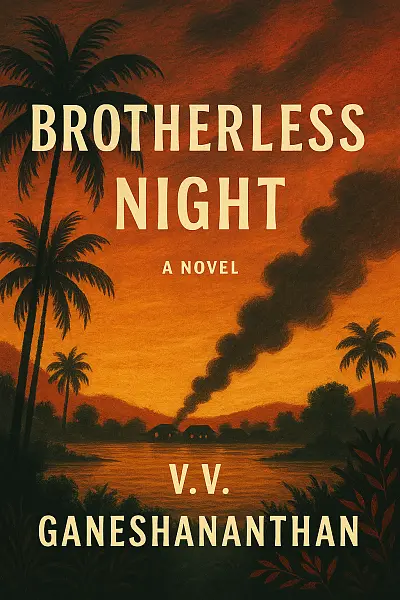
Brotherless Night
Sixteen-year-old Sashi dreams of becoming a doctor in 1980s Jaffna, hoping to heal her community amid the mounting tensions of Sri Lanka's civil war. Her peaceful ambitions shatter when violence erupts and her brothers are pulled into the Tamil Tiger insurgency.
Desperate to protect her loved ones, Sashi joins the militants as a medic, but soon reels from betrayals and brutality on all sides, forcing her to confront terrifying questions about complicity and justice.
Ganeshananthan’s vivid, immersive style pulls you into Sashi’s moral journey, making every heartbreak and flicker of hope feel raw and immediate.
""In a world divided by war, the hardest courage is remembering the grief you share with those you’re told to hate.""
Let's Break This Down
The Author's Voice
Atmosphere:
Brotherless Night hums with a rich sense of place—expect a dense, immersive evocation of war-torn Sri Lanka. The mood is often tense and intimate, blending palpable fear with moments of bittersweet tenderness. There’s a persistent undercurrent of looming danger, yet the descriptions flood in warmth and life – you’ll practically feel the humid air and the ache of loss pressing in from every page.
Prose Style:
Ganeshananthan’s prose is lyrical yet lucid—sentences flow with a quiet elegance that never distracts from clarity. There’s nothing overwrought or showy, but every word feels chosen with care, shimmering with subtle emotional undercurrents. Dialogue rings natural, and the narrative carefully balances poetic observation and restrained reportage, leaning into vivid sensory detail without slipping into excess.
Pacing:
Expect a steady, deliberate pace, one that’s deeply attuned to the rhythms of everyday life disrupted by violence. This isn’t a novel that rushes—rather, it invites you to linger and absorb. That said, the forward momentum never falters: pivotal moments of chaos and heartbreak are delivered with real punch, but much of the novel works in quiet buildups and layered revelations. Think slow-burn, emotionally potent storytelling with periodic surges of intensity.
Character Focus:
The writing is intimately character-driven, with a close third-person lens that brings young Sashi’s hopes, fears, and doubts into sharp relief. Supporting characters are drawn with poignant specificity, their arcs unfolding gradually as the shifting tides of politics and violence push at loyalties and beliefs. Expect deep, internal storytelling—the characters’ inner lives are foregrounded just as much as external events.
Dialogue and Voice:
You’ll notice naturalistic dialogue infused with Tamil culture and expressions, lending authenticity without ever feeling forced. The narrative voice balances observational honesty and empathetic warmth, pulling you quietly into Sashi’s world.
Overall Mood:
The tone is achingly human, at times mournful, always compassionate. Prepare for a read that echoes with moral complexity, the lingering pain of loss, and stubborn hope—a book that asks you to sit with its characters in their moments of devastation and grace.
Key Moments
- Blood ties and betrayal in Jaffna’s shadowy alleys
- A family dinner turned battlefield—loyalty splintering with every whispered accusation
- Lyrical, searing prose that drops you right into the humid tension of wartime Sri Lanka
- A medical student's dream unraveling as violence closes in—what price survival, what cost compassion?
- Radha’s heart-shattering choices between kin and conscience
- The rebel safe house scene—claustrophobic, electric, impossible to forget
- Quiet moments of hope shining through the chaos, as lifelines and love flicker in a warzone
Plot Summary (Spoilers Throughout!)
Brotherless Night by V.V. Ganeshananthan follows Sashi, a passionate teenager pursuing her dream of becoming a doctor in 1980s Sri Lanka as civil war erupts between the Tamil minority and Sinhalese-dominated government. Her four beloved brothers are drawn, one by one, into the deadly world of Tamil Tigers (LTTE) insurgency or are claimed by violence, shattering her family’s stability. As Sashi is swept into the conflict—working in hospitals, witnessing atrocities on all sides, and struggling under the Tigers’ moral complexities—she must navigate impossible choices between resistance and survival. The novel climaxes with her brothers’ deaths, her own deepening entanglement with the rebel movement, and a devastating loss of innocence. In the end, Sashi is left scarred but resolute, determined to bear witness to the war’s tragedy and retain her humanity despite overwhelming loss.
Character Analysis
Sashi is a fiercely intelligent and empathetic protagonist, shaped by personal loss and political upheaval. Initially steadfast in her pacifist ambitions, she is gradually forced into moral gray zones as violence and loyalty to family pull her deeper into the conflict. Her brothers represent different responses to war—some idealistic, others reluctant or pragmatic—mirroring the divided Tamil community. Supporting characters, including Tiger leaders and Sashi’s friends and colleagues, are nuanced, showcasing trauma and hope, as each wrestles with the costs and corruptions of prolonged war.
Major Themes
At its core, Brotherless Night explores the devastating effects of civil war on families, especially from a woman’s perspective, and the moral compromises war demands. The novel interrogates the idea of heroism versus survival, as Sashi must decide whether to speak up or stay silent in the face of brutality—including violence by those she loves or respects. The interplay of memory and truth stands out, with Sashi wrestling with which stories deserve to be told and the impact of collective versus personal narratives. Ganeshananthan also examines how gender permeates every experience of war—Sashi faces not just violence, but the unique pressures put upon women as caretakers and silent witnesses.
Literary Techniques & Style
Ganeshananthan employs clear, lyrical prose—striking a balance between intimacy and reportage—that draws readers deeply into Sashi’s interior world. The use of first-person narrative creates immediacy and allows for introspection, while non-linear storytelling, with flashbacks and memories interspersed, mirrors the fragmentation caused by trauma. Symbolism abounds: blood, night, and the recurring image of the brotherless state represent loss and the destruction of familial anchors. Subtle metaphors and cultural references—especially medical ones through Sashi’s training—amplify the sense of life delicately balanced amid chaos.
Historical/Cultural Context
Set against the backdrop of the Sri Lankan Civil War (1983–2009), the novel is deeply rooted in the Tamil experience of ethnic violence, displacement, and diaspora. Real historical events—including Black July, enforced disappearances, and internecine Tamil conflicts—inform the personal tragedies Sashi endures. The rich cultural and religious traditions of Jaffna’s Tamil community underpin everyday life, providing both solace and additional layers of conflict.
Critical Significance & Impact
Brotherless Night stands out for centering women in war narratives, offering a rarely heard voice from the Sri Lankan conflict with unflinching honesty. Critics have praised its nuance, refusal of easy binaries, and compassionate exploration of trauma—cementing its importance in contemporary literature about war, diaspora, and resilience. Its lasting relevance lies in its universal questions about violence, activism, and the consequences of silence, making it a powerful tool for discussion in both high school and college classrooms.
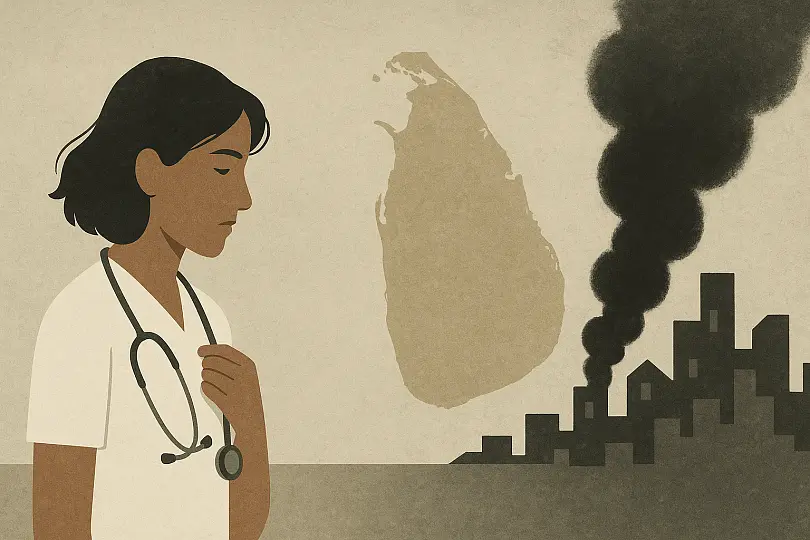
War-torn loyalties collide with lost innocence in a haunting Sri Lankan saga
What Readers Are Saying
Right for You If
If you’re into literary fiction that digs deep into complicated histories and messy family bonds, Brotherless Night is totally up your alley. This one’s for readers who love being swept into intense, real-world conflicts and aren’t afraid of a heart-wrenching story that asks big questions about loyalty, violence, and what it means to survive.
- History buffs and anyone fascinated by the Sri Lankan civil war will find the backdrop genuinely compelling—Ganeshananthan brings it to life in a way that’s immersive and thought-provoking.
- If you enjoy books that don’t shy away from tough themes—like war, moral ambiguity, and grief—you’ll appreciate how honestly this one tackles its subject.
- Fans of character-driven dramas (think Min Jin Lee or Chimamanda Adichie) are going to connect with the layered, flawed people at the heart of this novel.
- Readers who love stories with strong, complex women—especially those becoming themselves in impossible circumstances—should definitely give this a shot.
That being said, if you like your stories fast-paced or you’re looking for a tidy, plot-heavy thriller, this novel might test your patience. The pacing can be a slow burn, and there’s a lot of historical and emotional nuance, so it’s better suited to folks who savor deep dives rather than quick rides. If heavy, bleak subject matter isn’t your thing, or you want total escapism, you might want something lighter.
But if you’re craving a thought-provoking, beautifully written story that sticks with you long after you turn the last page, Brotherless Night is absolutely worth your time.
What You're Getting Into
Set in the turbulent streets of 1980s Sri Lanka, Brotherless Night follows Sashi, a fiercely ambitious young woman striving to become a doctor amid a nation unraveling from war.
As violence erupts and loyalties are tested, Sashi is swept into a web of choices that pit her family, her ideals, and her own survival against each other.
This novel delivers a gripping blend of coming-of-age drama and political suspense, pulsing with emotional depth, moral complexity, and the haunting realities of conflict.
Characters You'll Meet
-
Sashi: Fiercely intelligent and compassionate protagonist whose dream of becoming a doctor is upended by the Sri Lankan civil war. Her moral struggles and determination to help her community shape the heart of the story.
-
K: Charismatic and passionate friend turned militant, K serves as both inspiration and cautionary tale for Sashi. His radicalization reflects the escalating violence and divisions in their world.
-
Siva: Sashi’s devoted older brother, whose involvement with the LTTE has profound consequences for the family. His choices force Sashi to confront the costs of loyalty and conflict.
-
Thava: Sashi's close childhood friend and later, an activist, Thava’s courage and compassion are rallying points for Sashi. He represents a hopeful, alternative path amid the chaos.
-
Appa: Sashi’s principled father, a schoolteacher unwilling to give up on fairness and education even as the world collapses around them. His steadfastness anchors Sashi’s values and choices.
More Like This
Fans of Chimamanda Ngozi Adichie’s Americanah will instantly recognize the intricate weaving of personal identity with sprawling political conflict in Brotherless Night*. Just as Adichie brings the Nigerian civil struggle to vivid life, Ganeshananthan plunges readers into the heart of Sri Lanka’s civil war, exploring how history shapes—and shatters—intimate relationships. The care with which both authors depict the consequences of violence on ordinary people creates an emotional resonance that lingers long after the last page.*
If Homegoing by Yaa Gyasi drew you in with its intergenerational pain and perseverance, you’ll be equally moved by how Brotherless Night traces the ripple effects of trauma across a family caught in national turmoil. Ganeshananthan shares Gyasi’s talent for illuminating heavy themes through deeply personal stories, providing a tapestry of grief, hope, and survival threaded with complex familial bonds.
On screen, The Kite Runner adaptation—based on Khaled Hosseini’s beloved novel—echoes Brotherless Night in its unforgettable portrayal of friendship fractured by loyalty, fear, and political upheaval. Both stories harness the power of memory and loss to fuel a gripping narrative, challenging viewers and readers to consider how individuals navigate the relentless tides of history and conscience.
Critic's Corner
How far does conscience survive amid relentless violence? Brotherless Night invites us to wrestle with this question through Sashi’s unforgettable journey—an unflinching exploration of what’s left when dreams and morality come under siege. It’s both a coming-of-age story and a chilling meditation on how political war reshapes the soul, family, and community.
Ganeshananthan’s writing is precise, elegant, and refreshingly unsentimental. She lays bare terror’s slow creep rather than leaning on melodrama. The first-person narrative feels intimate yet measured, imbuing Sashi’s voice with quiet resilience—her inner world rendered in careful detail. Dialogues ring true to life, mixing tenderness and pain, while sensory descriptions pull us into Jaffna’s fraught streets and makeshift hospitals. The use of time shifts and restraint in emotional exposition create a tone of authenticity, though at moments the careful pacing borders on detachment, and some readers may crave a sharper pulse in the story’s middle third. Nevertheless, the cumulative effect is devastatingly real: understated moments echo long after the page.
At its heart, the novel bravely asks what it means to choose amid impossible circumstances—loyalty to family, cause, truth, or simply survival? Ganeshananthan foregrounds moral ambiguity, never offering easy answers. She draws attention to the complex roles women play in war—not merely as victims, but as medics, witnesses, and resistors. The book illuminates the cost of violence, not just in death, but in fractured identities and lost futures. Brotherless Night is also a powerful reckoning with collective memory, echoing current global debates on documentation, justice, and forgotten histories. The story never shies away from the messiness of resistance—characters struggle, betray, rationalize, regret—making each choice achingly human. The intersection of feminism, nationalism, and trauma is handled with the deftness of a writer deeply invested in these questions.
Within contemporary war novels, Brotherless Night stands apart for the specificity of its Sri Lankan setting and its fierce commitment to nuance. Readers of Kamila Shamsie’s "Home Fire" or Chimamanda Ngozi Adichie’s "Half of a Yellow Sun" will appreciate Ganeshananthan’s refusal to flatten history into allegory. While her earlier works touched on diaspora, here she anchors story and political critique firmly in lived reality, offering a window seldom seen in Anglophone literature.
If there’s a weakness, it’s the occasional emotional distance that the tightly controlled prose imposes—sometimes muting what could be a rawer reading experience. Still, the novel’s immersive sense of place, moral complexity, and compassionate gaze linger long after finishing. Brotherless Night doesn’t just recount a war; it compels us to reflect on how we witness and remember, making it an urgent, resonant contribution to the canon of war literature today.
Community Thoughts
okay, but that scene with Sashi and the radio? i literally had to stop reading and stare at the wall for ten minutes. the tension and heartbreak just swallowed me whole. i’ll never look at radios the same way again.
When Sarath first appeared, I thought he’d be just another side character, but his choices left me reeling. I kept turning pages, hoping for redemption or understanding. He stayed with me, long after I finished.
oh my god, i can't stop thinking about Sashi. her choices and silences have been stuck in my head for days. i keep replaying that one hospital scene, trying to figure out if i would have done anything differently.
there’s this one line about the cost of survival that hit me so hard I kept rereading it at 2 am. I thought I’d move on but nope, it lingers like a bruise. Ganeshananthan just will not let you sleep peacefully.
okay but remember that scene with Sashi standing alone on the roof, caught between hope and devastation? that visual stuck in my mind for days. Ganeshananthan nails the ache of divided loyalties.
Leave Your Review
Local Take
Why It Matters
Oh wow, Brotherless Night by V.V. Ganeshananthan really hits home if you’re coming at it from a Sri Lankan perspective!
-
Those gritty depictions of civil war, fractured families, and impossible moral choices? They’ll feel eerily familiar to anyone who’s experienced or studied Sri Lanka’s conflict years. The echoes of lost youth, propaganda, and the personal cost of violence will resonate especially deeply for locals who still grapple with the legacy of the LTTE war.
-
Plot twists that involve betrayal, shifting loyalties, and blurred lines between heroes and villains? That’s practically baked into our conversations about post-war justice, truth, and reconciliation. Some moments—like the protagonist’s desperate struggle to stay morally upright amid chaos—may dig up collective memories or even family histories.
-
Culturally, the emphasis on family duty, sacrifice, and community identity aligns with local values, but the book also nudges gently at taboos around questioning authority and tradition, which might feel brave or even uncomfortable here.
-
In terms of literary tradition: The novel’s raw emotional honesty and willingness to critique all sides echo the work of Sri Lankan writers like Shyam Selvadurai, yet its focus on a woman’s perspective and medical ethics in wartime feels super fresh and boundary-pushing locally.
All in all, it’s one of those stories that feels both intimately Sri Lankan and universally human—guaranteed to spark some heated dinner table debates!
Food for Thought
Brotherless Night by V.V. Ganeshananthan
This novel was longlisted for the 2023 Women’s Prize for Fiction, drawing widespread praise for its powerful exploration of civil war and personal resilience. Its in-depth portrayal of Sri Lanka’s tumultuous history has sparked important conversations and increased visibility for Tamil voices in contemporary fiction.
Like what you see? Share it with other readers