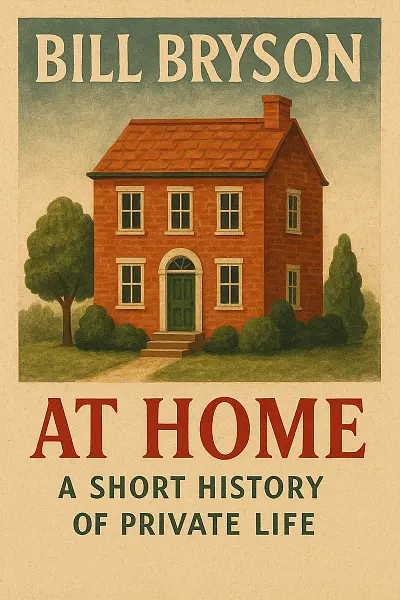
At Home: A Short History of Private Life
by: Bill Bryson
Bill Bryson lives with his family in a quaint Victorian parsonage in rural England, feeling comfortably settled yet nagged by curiosity about his home's everyday details. One day, struck by how much he takes for granted, he’s hit with an idea: explore the hidden histories behind every room and object in his house.
As Bryson digs deeper, each familiar space—a chilly hallway, an unremarkable kitchen, a quiet attic—becomes a portal to wild stories of innovation, disaster, and transformation. Along the way, he wrestles with questions about how private life reflects broader world history, making us wonder: How much of the world has seeped into our walls?
""The story of our homes is the story of how ordinary corners quietly shape the course of human history.""
Let's Break This Down
The Author's Voice
Atmosphere
Light, intimate, and richly detailed, Bryson's book feels like being invited into an eccentric but cozy home where every object holds a story. There’s a gentle sense of curiosity that makes even the mundane seem fascinating, while historical trivia and quirky anecdotes create a playful yet thoughtful mood. The atmosphere is never stuffy; instead, it’s endlessly welcoming and wonder-filled, turning each chapter into a friendly chat across centuries.
Prose Style
Bryson’s signature wit sparkles throughout—his sentences are crisp, fluid, and peppered with sly humor. The writing balances clarity and charm, with a knack for untangling complex information into accessible, conversational narration. You’ll notice sly asides and tongue-in-cheek observations that give the prose a warm, raconteur’s energy, never feeling pedantic or droning.
Pacing
Leisurely yet addictive. Bryson strolls through history at an unhurried pace, pausing for diversions and tangents that are almost always worth the detour. The pace favors discovery over urgency—think of it as a series of fascinating, loosely connected short stories stitched together, rather than a tightly plotted narrative. For some, the meandering can be delightful; for others, a little patience pays off.
Character & Voice
There are no traditional characters, but Bryson himself becomes the endearingly inquisitive guide. His voice is warm, self-deprecating, and relentlessly enthusiastic—you always feel in the company of someone deeply curious and eager to share his latest oddball findings. The book’s quirky, personal touch makes even historical figures and concepts come alive with personality.
Themes & Structure
Bryson weaves together history, science, design, and human experience under the roof of “home.” He tackles grand subjects by shrinking them down to everyday objects, drawing sharp connections between past and present. The thematic structure is episodic, hopping seamlessly from room to room, topic to topic, making each section a mini-exploration of how ordinary life is shaped by extraordinary stories.
Overall Rhythm & Mood
Expect a playful, inquisitive rhythm—the book often meanders but reliably uncovers gems along the way. It’s perfect for readers who love learning through anecdotes and aren’t rushing for the finish line. Every page seems to nudge you to look at your own home with fresh eyes and a deeper sense of curiosity for the hidden histories all around you.
Key Moments
-
Witty deep dives into the ordinary—why your saltshaker and staircase both have wild backstories
-
Unexpected adventures through the attic and cellar, unearthing Victorian secrets and quirky inventions
-
That hilarious chapter where Bryson obsesses over the history of the hallway
-
Playfully snarky asides about cholera, rats, and the not-so-glamorous truth behind domestic bliss
-
Ingenious connections between architecture, social change, and everyday habits—all from the comfort of his Norfolk rectory
-
Moments of genuine awe at the surprising ways mundane objects shaped empires and life as we know it
Plot Summary
At Home: A Short History of Private Life by Bill Bryson isn’t a traditional narrative, but rather a fascinating tour through the rooms of an English country house, using each space as a springboard for exploring the history of domestic life. The book opens in Bryson’s Victorian-era rectory in Norfolk, and with each chapter, he moves to a different room—kitchen, bedroom, dining room, and so on—uncovering how everyday comforts and routines came to be. Along the way, he delves into anecdotes about salt mines, plumbing disasters, architectural innovations, and the people who revolutionized private life, such as inventors, servants, and eccentric aristocrats. Bryson’s digressions are the heartbeat of the book: quirky facts and unexpected historical twists keep popping up, but ultimately he weaves everything together to underscore how seemingly mundane features of our homes are rooted in astonishing events and personalities. The “climax” is less a single moment and more a realization for the reader—the home, Bryson shows, isn’t isolated at all but intimately entangled with world history, innovation, and even catastrophe, leaving us with a new appreciation for the ordinary.
Character Analysis
Instead of fictional characters, Bryson himself is both the narrator and the primary “character,” acting as our witty, endlessly curious guide. His perspective is personable and approachable, blending personal anecdotes with researched facts for a friendly, conversational style. While the reader encounters a “cast” of historical figures (from John Lubbock to Thomas Crapper), they appear more as colorful cameos than fully developed characters—chosen to illustrate broader trends or turning points in the history of domestic spaces. Bryson’s motivation remains clear throughout: to demystify everyday life, reveal its unexpected origins, and remind us of our odd, inventive human heritage.
Major Themes
The central theme revolves around the extraordinary origins of the ordinary—how even the most familiar conveniences in our homes are the products of fascinating, often accidental, historical developments. Bryson also probes innovation and progress, highlighting how leaps in comfort or hygiene often resulted from disaster, serendipity, or the determination of overlooked inventors, as with the story of household plumbing. Throughout, there’s an undercurrent about the invisible labor and class structures that shaped private life, revealed through anecdotes about servants, industrialization, and shifting domestic roles. Finally, the book repeatedly emphasizes interconnectedness: the way domestic life is shaped not just by local custom but also by sweeping global events, chance encounters, and forgotten individuals.
Literary Techniques & Style
Bryson’s style sparkles with anecdote-driven narrative, packed with digressions that keep things lively and unpredictable. He leans heavily on wry humor, irony, and sarcasm, which makes dense information feel fun and accessible. His structure—organizing the book by rooms rather than chronology—not only provides a fresh perspective, but also serves as an extended metaphor for the compartmentalization of knowledge and the surprising way everything connects. Bryson’s frequent use of metaphor (such as comparing the house to a microcosm of society) and occasional symbolism (like the secret passageways or attics hiding histories) deepen the text without weighing it down.
Historical/Cultural Context
The book is set in early 21st-century England, but its scope is breathtakingly wide, stretching from ancient civilizations to the Victorian era and beyond. The catalyst for the narrative is Bryson’s residence in a 19th-century rectory, and the societal shifts—from the Industrial Revolution to Victorian ideals of privacy—are central. The story unfolds against the backdrop of Western domestic evolution, influenced by class, colonial exchanges, technological advances, and changing gender roles, all of which transform the meaning and function of “home.”
Critical Significance & Impact
At Home stands out as a genre-defying blend of history, architecture, science, and cultural commentary, making it a go-to popular history text on the hidden story of everyday life. It was widely praised for its readability, scope, and Bryson’s signature wit, sparking renewed interest in the history of domesticity and the importance of small innovations. Its lasting impact is its ability to make readers reconsider their everyday environment, suggesting that even the most ordinary places are sprinkled with stories worth telling.
The secret stories of home, revealed with wit and wonder
What Readers Are Saying
Right for You If
Target Audience for At Home: A Short History of Private Life
If you’re the kind of person who loves random bits of trivia, gets sucked into Wikipedia rabbit holes, or finds yourself wondering about the story behind everyday things, you’re honestly going to have a blast with this book. Bill Bryson’s writing feels like having a clever (and slightly cheeky) friend walk you through quirky, surprising, sometimes laugh-out-loud histories that are hiding right in your house. History buffs who don’t always want to commit to dense, textbook-style tomes—this is totally your jam. The book’s also a solid pick for folks who enjoy nonfiction that reads almost like storytelling, with a dash of humor and a lot of “wow, who knew?” moments.
On the flip side, if you’re looking for a novel with a clear plot or deep, emotional character arcs, you probably won’t find what you want here. The structure is more meandering than linear—great for curiosity-driven readers, but maybe frustrating for someone who likes things neat and focused. Some chapters go off on delightful tangents (which makes Bryson, well, Bryson), but if you’re after a tightly organized, academic history, this probably isn’t your book.
So, curious souls, history dabblers, and fans of delightfully odd facts—you’ll love this. But if you’re all about strong narratives, gripping drama, or strictly chronological stories, you might want to skip it (or save it for when you’re in the mood for something light, chatty, and fascinatingly offbeat).
What You're Getting Into
Ever wondered what secrets lurk within the walls of your own home? In At Home: A Short History of Private Life, Bill Bryson takes readers on an irresistibly quirky stroll through a classic English rectory, using each room as a springboard into fascinating backstories about how modern domestic comforts came to be.
With trademark wit and curiosity, Bryson uncovers the surprising, sometimes bizarre origins of everyday objects and customs, revealing the hidden drama in even the most mundane corners of our lives.
Part history lesson, part grand adventure, and all-around entertaining, this book feels like wandering through your own house with the most charming guide imaginable—who never runs out of intriguing tales to tell.
Characters You'll Meet
-
Bill Bryson: Curious, witty narrator who guides readers through the history of domestic life, blending personal anecdotes with fascinating research. His inquisitive nature and humor serve as the driving force of the book.
-
Catherine, Bryson's wife: Often referenced in stories and anecdotes, she grounds Bryson's explorations by embodying the present-day domestic experience and prompting some of his inquiries.
-
May Savidge: Featured in Bryson's exploration of home preservation, her eccentricity and love for her home highlight the emotional connections people forge with their living spaces.
-
Early home innovators (e.g., John Lubbock, Thomas Jefferson): These historical figures pop up as colorful examples, their inventions and passions representing the spirit of curiosity and innovation that shaped modern household life.
-
Victorian servants (collectively): Represented throughout as essential, often overlooked contributors who maintained the daily life of homes, illustrating the unseen labor and social structures underpinning domestic history.
More Like This
You know that delightful sense of curiosity sparked by A Short History of Nearly Everything by Bill Bryson? At Home brings a similar blend of wit, warmth, and wanderlust—only this time it unpacks the hidden history lurking in your living room, kitchen, and even the garden shed. If you’ve ever been swept up in the quirky, detailed storytelling of Mary Roach’s Packing for Mars, you’ll find familiar joy here; Bryson shares Roach’s knack for transforming mundane details into jaw-dropping anecdotes, but through the lens of domestic life rather than outer space.
There’s also a clever, conversational tone throughout that fans of Stephen Fry’s QI might instantly recognize: tangents and trivia tidbits pop up with the same playful unpredictability, making you want to shout, “Did you know?” across the room every few pages.
On screen, At Home’s deep-dive explorations and surprising historical revelations feel right at home alongside the BBC’s QI or even the BBC documentary series A House Through Time. Like those shows, Bryson peels back the layers of ordinary places to reveal the chaos, invention, and colorful characters behind our daily routines—so if you’re a sucker for history served with charm, you’re in for a treat.
Critic's Corner
Is it possible that every ordinary object around us—those doorknobs, bathtubs, even salt shakers—holds the key to understanding civilization itself? In At Home: A Short History of Private Life, Bill Bryson joyfully upends any illusion that our homes are mere shelters from history. Instead, he asks readers to look closer, suggesting the comfort and clutter of daily domesticity are where the grand sweep of human existence comes to rest—in quiet, dusty corners.
Bryson’s writing once again sparkles with wit, intimacy, and curiosity. His signature style, breezy yet impressively erudite, transforms potentially mundane subjects—like the invention of the fuse or the shifting fashions of tableware—into a cavalcade of memorable anecdotes. The book’s room-by-room structure offers a clever scaffolding, creating a sense of discovery and movement without ever feeling gimmicky. Bryson excels at deploying digressions that illuminate rather than distract; one minute, he’s pondering Victorian plumbing, the next he’s charting the spice routes that reconfigured global empires. There’s a conversational charm throughout, full of dry humor (“consider the humble salt cellar...”) and affectionate asides, making the historical trivia feel relevant and deeply human. On rare occasions, the density of facts can become overwhelming, but overall, Bryson’s light touch and narrative discipline save the reader from exhaustion, even as he leaps from medieval cesspits to the birth of the telephone.
Thematically, At Home is as ambitious as any epic. Bryson threads together ideas of progress and privacy, cultural memory, and the faint but persistent echoes of class and gender that cling to our bedrooms and kitchens. He probes the way technological advances—like glass windows or running water—have quietly but radically reshaped not just households but social norms and personal expectations. There’s a gentle but persistent questioning of “normal,” as Bryson demonstrates that much of what we take for granted is the result of chaotic, unintended historical forces. The work also raises intriguing philosophical questions: To what extent is domesticity universal, and where do private lives intersect with grand historical currents? Particularly resonant now, as so many reconsider the meaning of “home” in turbulent times, Bryson’s meditation feels timely and urgent, nudging readers to explore their daily environments with new eyes.
Placed alongside Bryson’s earlier work—especially A Short History of Nearly Everything—At Home stands out for its intimacy. Where his previous books traverse continents and millennia, this volume delivers world history as a patchwork quilt of anecdotes stitched together by familiar doors, floors, and staircases. Within the tradition of domestic history—think Lucy Worsley or Amanda Vickery—Bryson’s knack for humor and synthesis makes this book especially accessible to the general reader.
If there’s a flaw, it’s that the digressive style can occasionally leave themes feeling scattered, and some stories cry out for deeper analysis. Yet, the book’s warmth, intelligence, and scope far outweigh these quibbles. For anyone curious about why their house is what it is—or seeking proof that the ordinary truly is extraordinary—At Home is an engaging, delightful treasure trove.
Community Thoughts
I woke up at 3am thinking about Victorian plumbing after reading this. Bryson makes doorknobs and dust seem wild. My sleep schedule is ruined and now I can’t look at my house the same way. Seriously, why is everything so weird and fascinating?
totally lost sleep over bryson’s weird obsession with salt and dust. why did he make me care about the history of stairs? suddenly i’m inspecting my own house for secret medieval quirks.
was not expecting to get deeply invested in the origin of the hallway but now i’m side-eyeing every corridor in my house. bryson’s wild tangents wrecked my bedtime for a week. how did we ever live without flushing toilets?
I picked it up to skim and ended up reading until 3 a.m., brain fizzing with facts about hallways and toilets. Bryson’s curiosity is a caffeine shot for your mind. Now every creak in my house feels suspiciously historical.
i started this thinking it was about houses, but suddenly i'm deep in rat plagues and arsenic wallpaper. bryson’s wild tangents had me googling at 2am. i’ll never look at my hallway the same way again.
Leave Your Review
Local Take
Why It Matters
At Home: A Short History of Private Life by Bill Bryson totally vibes with readers here because it peels back the curtain on domestic life—something that resonates in a culture where family, home, and tradition hold deep significance.
-
Bryson’s exploration of how tiny inventions and social shifts shaped home life feels familiar, especially given this country’s own history of blending old customs with bursts of modernization. Think about post-war urbanization or rural to city migrations—local readers recognize these transformations mirrored in their own grandparents’ stories.
-
There’s a satisfying parallel between Bryson’s charming, sometimes eccentric anecdotes and our affection for quirky family lore and ancestral homes. But his British lens on class and architecture sometimes feels a bit fancy, clashing with the local value of practicality and communal living over rigid formality.
-
The book’s leisurely, humorous storytelling echoes beloved local essayists, though Bryson’s global sweep challenges more regionally-focused literary traditions here. What really hits home? His reminder that history is lived in ordinary spaces—a message totally at home with this culture’s respect for the meaning behind humble, everyday things.
Food for Thought
Notable Achievement
- At Home: A Short History of Private Life has cemented its place as an international bestseller, celebrated for making the history of everyday domestic life both accessible and fascinating to a wide audience.
- The book’s quirky, digressive style has prompted countless readers to look at their own homes in a new light, sparking renewed interest in social history and the hidden stories behind mundane objects and routines.
Like what you see? Share it with other readers