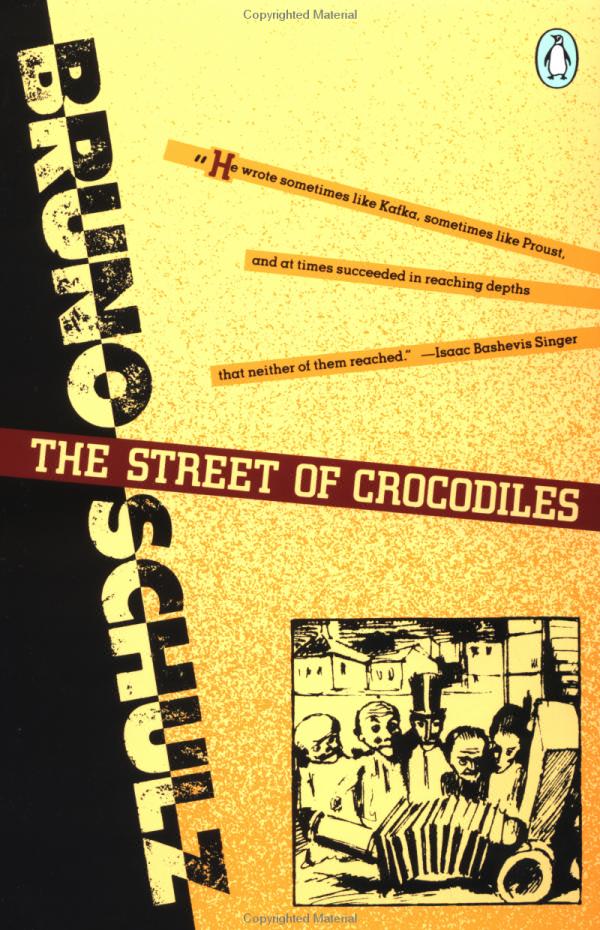
The Street of Crocodiles
by: Bruno Schulz
Jakub, a dreamy boy, grows up amid the faded streets of Drohobycz—especially the surreal Street of Crocodiles, where reality and imagination blur daily. His eccentric father’s obsessions—breeding exotic birds and empathizing with tailors’ dummies—pull the entire family into bizarre rituals that unsettle their fragile order.
When Jakub’s father’s behavior grows more erratic, the family’s grip on normalcy slips, forcing Jakub to navigate a world where sanity teeters on the edge and identity feels fluid. Jakub yearns for connection, but risks losing himself to his father’s increasingly uncanny visions.
Schulz’s writing casts a dreamlike, unsettling spell—part nostalgia, part waking nightmare.
""In the tangled alleys of memory, wonder and decay are woven from the same fragile thread.""
Let's Break This Down
The Author's Voice
Atmosphere
Dreamy, enigmatic, and tinged with nostalgia, the vibe here is thick as fog—think faded city streets haunted by memories and surreal fragments of childhood. Schulz conjures a moody, cinematic landscape where every corner shimmers with fantasy and unease. The mundane is transformed into something almost mystical, so expect a lush tapestry of longing, melancholy, and wonder that can feel both inviting and strange.
Prose Style
Schulz’s sentences spiral and bloom, mixing poetic flourishes with bursts of hallucinatory imagery. Expect paragraphs that beg to be reread for their beauty and density—he’s not afraid of a metaphor that runs wild. The language is lush, painterly, and sometimes overwhelming, stuffed with rich, tactile descriptions and gorgeously bizarre turns of phrase. If you’re a fan of lyrical prose, you’ll be in heaven; if you prefer clean minimalism, brace yourself for a baroque feast.
Pacing
Loose and wandering—this is not a book in a hurry. The plot unfolds in little vignettes, almost like daydreams stitched together rather than a traditional narrative march. It drifts, pauses, circles back on itself, allowing you to soak in every detail but sometimes leaving you wondering if you’re moving forward at all. Perfect for savoring slowly, less so if you crave fast payoffs or suspenseful momentum.
Character Development
Characters emerge through shimmering impressions rather than concrete psychology. The narrator’s family, especially his eccentric father, often feel more like mythic figures or symbols than flesh-and-blood people. Relationships are sketched in broad, evocative strokes—what matters is how they embody the book’s surreal mood, not how realistically they behave. Go in expecting archetypes and dream-logic rather than deep dives into personal growth.
Themes
Big on memory, the collapse of reality into fantasy, family oddities, and the mysterious transformation of everyday life. Schulz probes the strangeness at the heart of domestic existence and childhood, with a steady undercurrent of loss and the uncanny. It’s all about seeing the ordinary through an enchanted, slightly unsettling lens—each story peels back the surface of normalcy to reveal glittering, shadowy layers beneath.
Overall Rhythm and Feel
Immerse yourself in a slow-burn fever dream, equal parts enchanting and unsettling. Schulz crafts a literary labyrinth: you don’t so much read The Street of Crocodiles as drift through its haunted halls, discovering beauty and eeriness in equal measure. Perfect for lovers of poetic, atmospheric fiction who like to linger in the strangeness well after closing the book.
Key Moments
- Surreal store windows morph into dreamscapes—reality bends with every step
- Father's outlandish bird obsession—watch as pigeons become mythic, magical creatures
- Kafkaesque alleyways where time dissolves and logic twists
- That unforgettable “tailor’s dummy” sequence—equal parts eerie and enchanting
- Prose drips with lush, painterly detail—every sentence feels like a brushstroke
- Loneliness and wonder coexist in a world both mundane and utterly bizarre
- Schulz turns childhood memories into shimmering, haunting fairy tales
Plot Summary
The Street of Crocodiles sweeps readers through a dreamlike, fragmented journey set in a Polish town resembling the author’s Drohobych. Instead of a traditional, linear narrative, the book unfolds as a series of interlinked vignettes told by an unnamed narrator who observes his eccentric family, especially his father’s descent into obsession and madness. Key episodes include Father’s bizarre experiments with bird-raising, his fixation on the tailor Adela, and the transformation of the town’s commercial district, “The Street of Crocodiles,” into a carnival of grotesque modernity and decay. As each chapter slips between reality and surreal fantasy, there’s no conventional climax, but a gradual unraveling: the narrator’s childhood certainties waver, the family drifts apart, and the town itself mutates into something unrecognizable. Ultimately, the book closes with a lingering sense of loss, change, and haunting doubt—leaving the narrator (and us) to reckon with memory’s distortions.
Character Analysis
The narrator acts as both participant and observer, capturing his coming-of-age through tinted glasses of nostalgia and fantasy, though his own growth is subtle and often overshadowed by his father’s peculiarity. Father, easily the novel’s most magnetic figure, transforms from an ordinary shopkeeper to a visionary bordering on delusion—his wild inventions and philosophical flights become metaphors for creativity, alienation, and decline. Adela, the maid, is an ambiguous blend of earthy practicality and mysterious allure, guiding the domestic world but also disrupting it with her power over Father and the household. Other side characters—Mother, shop assistants, townsfolk—are sketched more impressionistically, often privileging atmosphere and mood over psychological realism.
Major Themes
- Memory and Imagination: Schulz blurs the boundaries between recollection and invention, suggesting that the past is always reshaped by the stories we tell ourselves. The narrator’s fluid, fantastical memories raise questions about what’s real and what’s imagined.
- Transformation and Decay: Change pulses through the book—from Father’s madcap experiments to the sinister evolution of “The Street of Crocodiles” itself, the story obsesses over metamorphosis, entropy, and irretrievable loss.
- Alienation and Modernity: The arrival of the commercial, artificial street signals a world in flux, where old certainties—tradition, family, identity—are eroded under the pressures of modern life.
- The Power of Art: Father’s creative impulses (however absurd) and the narrator’s lush prose both hint at art’s ability to re-enchant—or distort—the everyday.
Literary Techniques & Style
Schulz dazzles with lush, lyrical prose that swells with metaphors and vivid imagery, often turning the mundane into the magical—a pile of tailors’ fabric becomes an ocean, a cockroach metamorphoses into a philosopher. The narrative structure is nonlinear and episodic, intentionally disorienting, refusing easy chronology in favor of emotional and sensory logic. Symbolism is everywhere: birds stand for transcendence, “The Street of Crocodiles” is symbolic of soulless modernity, and insects signal decay and transformation. Language itself bends reality, with metaphors layering meaning upon meaning, making the ordinary world shimmer with the bizarre.
Historical/Cultural Context
Set in the early 20th-century town modeled on Schulz’s own prewar Polish-Jewish shtetl, the book thrums with the anxiety of a disappearing way of life. Cultural tensions—between tradition and modernization, old world and new—infuse the story’s atmosphere, echoing larger historical forces pressing on Eastern Europe at the time. The looming sense of loss and change foreshadows the catastrophic upheavals of the century, especially for Jewish communities.
Critical Significance & Impact
Schulz’s only two books, The Street of Crocodiles and its follow-up, catapulted him to status as a cult literary icon—praised for their one-of-a-kind blend of poetic invention, psychological depth, and surrealist imagery. Though his work was underappreciated during his life, he’s now frequently cited alongside Kafka and Proust for exploring the territory between fantasy and reality. The book’s influence is seen everywhere from visual art (the Brothers Quay’s film adaptation!) to postmodern literature, and it remains a touchstone for anyone captivated by the ambiguity and beauty of memory.
Surreal childhood memories tangled in the shimmering haze of myth
What Readers Are Saying
Right for You If
If you're into books that are more about mood and imagination than fast-paced action, The Street of Crocodiles is seriously your cup of tea. This one is perfect for:
- Lovers of lush, weird, gorgeous prose — If you can get lost in beautifully strange sentences and don’t mind rereading lines just for the pure sound of them, you’re going to adore Schulz.
- Fans of surrealism and dreamlike stories — People who like Kafka, Calvino, or even a bit of magic realism will vibe here. It’s less about plot, more about drifting through this oddly enchanting city.
- Readers who appreciate symbolism and depth — If you’re the type who enjoys unpacking what the heck it all means and don’t mind ambiguity, there’s so much to dig into.
But honestly, this book isn’t for everyone:
- If you crave a clear, straightforward story with a big plot, honestly, you’ll probably find yourself frustrated.
- Pacing-wise, it can meander and gets a little abstract, so if you want something super gripping or easy to follow, you might end up skipping pages (or wishing you did).
- For folks who just want relatable characters and a direct emotional arc—this one’s more poetic and surreal than heartfelt or plot-driven.
So, if you’re in the mood for something unusual, beautifully written, and maybe a little bit strange, give it a shot! Otherwise, no shame in skipping it—this one’s definitely not everyone’s flavor.
What You're Getting Into
The Street of Crocodiles by Bruno Schulz sweeps you into a dreamlike Polish town seen through the eyes of a curious young narrator, where reality constantly blurs with surreal wonder. At the heart of the story is his eccentric family—especially his enigmatic father—whose mysterious obsessions and wild imaginings color every corner of their daily life. If you love rich, magical storytelling that’s as much about mood and longing as it is about plot, this poetic journey will wrap you in its strange, enchanting world!
Characters You'll Meet
-
Jakub (the Father): Eccentric and imaginative, Jakub is the family’s inventive patriarch whose fantastical obsessions and philosophical musings drive much of the book’s surreal atmosphere.
-
The Narrator (Joseph, Schulz’s alter ego): A sensitive and observant boy, he filters the bizarre world of his family and town through a dreamy, poetic lens, often blurring reality and imagination.
-
Adela: The sharp, practical maid, Adela grounds the household with her energy and presence, often clashing with Jakub’s oddities while commanding a unique authority in the family dynamic.
-
Mother: Quiet and pragmatic, she provides a stabilizing influence amid the chaos, managing daily life and offering a stark counterpoint to her husband’s flights of fancy.
-
Uncle Charles: A secondary but memorable figure, he exemplifies the routine mundanity of small-town life and subtly highlights Jakub’s difference from the rest of the family.
More Like This
Looking for books that spin reality into poetic, surreal tapestries? The Street of Crocodiles conjures a dreamlike atmosphere reminiscent of Franz Kafka's The Metamorphosis, with both works immersing you in worlds where the ordinary becomes disturbingly strange—expect that same sense of eerie wonder as reality contorts at the edges of everyday life. If you were captivated by the fragmented, memory-blurred storytelling of Italo Calvino's Invisible Cities, Schulz’s intricate, richly metaphoric vignettes will pull you in; both authors trade in lush prose and weave cityscapes that are more psychological landscapes than mere settings.
In another direction, fans of visually arresting and emotionally unsettling cinema will recognize the off-kilter whimsy and shadowy menace that recalls Guillermo del Toro’s Pan’s Labyrinth. Like del Toro’s film, The Street of Crocodiles lures you into a Gothic, fantastical vision full of haunting symbolism, where childlike awe mingles with existential dread. The result is a hypnotic narrative experience—part fever dream, part allegorical reflection on memory and identity—that lingers long after the final page.
Critic's Corner
What is memory if not a haunted landscape, echoing with the half-real, half-imagined figures of childhood? In The Street of Crocodiles, Bruno Schulz dives into this liminal space, daring us to question where reality ends and fantasy begins. He opens the attic of recollection and tumbles out the uncanny mess of growing up, leaving us unsure whether to be delighted or disturbed.
The magic of Schulz lies entirely in his languorous, atmospheric prose, which feels almost tactile—every image is lush, every sentence a strange, glimmering ornament. His narrative techniques are anything but conventional: linear time dissolves, replaced by looping memories and digressions that mimic the inscrutable logic of dreams. Schulz’s language has a painterly richness; texture and smell are rendered in strokes so sensual that the city of Drohobycz becomes vividly hallucinatory. He favors metaphor over plain description, so that every scene feels one step removed from waking life. At times, this lushness can tip into excess, the sentences growing so elaborate they nearly threaten to obscure meaning—but for the most part, this density is the point. Schulz isn’t just telling us stories; he’s conjuring a half-remembered world back to life.
Beneath the gorgeously torqued language lie themes that pulse with contemporary urgency: the frailty of identity, the instability of family, and the seductive allure of mythic thinking amid a mundane world. His father—part visionary, part tragic clown—embodies a refusal to submit entirely to prosaic reality, his wild obsessions exposing the brittleness of rational adult life. Schulz invites us to dwell in the ambiguity of wonder and alienation, asking: are we ever really free from the ghosts of childhood and community? In exploring the textures of Jewish merchant life and the surreal distortions of obsession, Schulz foreshadows both the catastrophic erasures to come and the resilience of cultural memory. The surrealism here isn’t escapism—it’s a way of refusing erasure, of insisting on the persistence of the imagination even under threat.
Schulz stakes out a unique spot in the literary landscape: more intimate and earthy than Kafka, yet equally drenched in dream logic; kin to Proust in his obsession with memory, yet more playful and perverse. His work stands alongside other modernist experiments in prose, but his voice—rich in melancholy and whimsy—remains impossible to mistake.
If Schulz’s style offers pleasures, it also risks frustrating the reader: the lack of narrative drive can feel drifty, and the lush prose, dazzling as it is, may induce fatigue over long stretches. Yet for those willing to surrender to its rhythms, The Street of Crocodiles is a trove of brilliant strangeness—a reminder of how much richness can be wrung from memory when approached with reckless honesty and a poet’s eye. With the world’s boundaries ever shaking, we need Schulz’s blurred lines now more than ever.
Community Thoughts
jacob’s odd stillness in The Street of Crocodiles lingers with me. his presence is both comforting and uncanny, like a half-remembered dream that won’t let go. i kept turning pages just to see what he’d do next.
Never thought a scene with mannequins would crawl under my skin like that. When the father vanished into his bizarre experiments, I genuinely felt my grip on reality slip. That image lingers—a fever dream I can't shake.
The mannequin sequence keeps replaying in my head. Schulz warped reality until I started seeing oddities in my own apartment corners. Sleep became a weird negotiation with shadows.
i finished The Street of Crocodiles and my BRAIN WON’T LET GO OF FATHER’S FREAKISH TRANSFORMATION. It’s stuck behind my eyes like a weird film—honestly, how do you sleep after reading that?
I still hear Father’s footsteps echoing in my dreams, like he’s searching for something I lost too; that uncanny presence lingers after every page, making the ordinary feel impossibly strange.
Leave Your Review
Local Take
Why It Matters
Bruno Schulz’s The Street of Crocodiles hits a unique chord in Polish readers, largely due to its wildly evocative depiction of a Jewish-Polish town set against the backdrop of early 20th-century Galicia.
-
Parallel Historical Echoes:
Many Polish readers instantly connect Schulz’s surreal, crumbling Drohobycz with the vanished Jewish communities wiped out by WWII, stirring collective memory of loss and dislocation. The book’s tension between decay and a yearning for magic mirrors Poland's own grappling with cultural erasure and rebirth after wartime devastation. -
Cultural Values:
Poland’s strong Catholic and folkloric traditions sometimes clash with Schulz’s playful, mystical, and occasionally erotic mysticism. Yet, there's a familiar melancholy and appreciation for the absurd that resonates powerfully with the Polish soul, especially in the way nostalgia and imagination stand as bulwarks against bleak reality. -
Plot Points & Literary Traditions:
The episodic, dreamlike structure might challenge Polish readers used to more straightforward storytelling, but echoes can be found in the works of Witold Gombrowicz and Stanisław Ignacy Witkiewicz. Schulz’s blending of lyricism with urban grotesque feels both distinctly local and cosmopolitan.
It’s a book that stirs up deep feelings about memory and identity—highlighting both a yearning for a lost world and a playful rebellion against realism, which Polish literature swings between, time and again.
Food for Thought
Notable Achievement & Cultural Impact:
The Street of Crocodiles by Bruno Schulz is celebrated as a classic of modernist literature, profoundly influencing writers like Philip Roth and David Grossman, and is widely admired for its dreamlike prose and imaginative evocation of Jewish-Polish life—earning a cult readership and a lasting place in twentieth-century world literature.
Like what you see? Share it with other readers