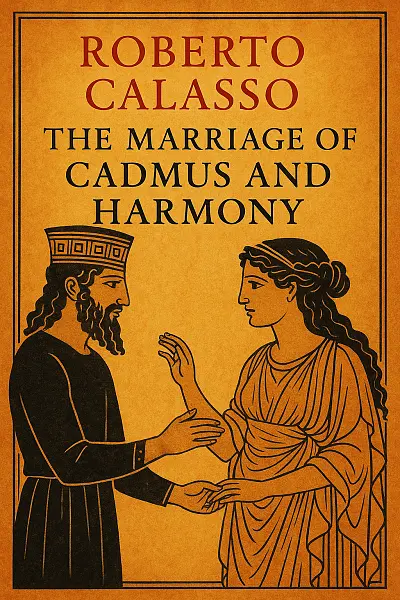
The Marriage of Cadmus and Harmony
by: Roberto Calasso
Cadmus, a wanderer haunted by loss, journeys through a mythic Greece shimmering with gods and monsters. Yearning for belonging, he searches for purpose until his fate intertwines with Harmony, a daughter of gods. Their union—heralded by divine guests—sparks a cascade of legendary tales, as personal desires collide with the whims of restless deities.
Legends swirl: lovers possess, mortals betray, heroes fall, and the line between fate and freedom blurs. Cadmus and Harmony stand at the heart of these stories, hoping to forge peace in a world ruled by chaos and passion.
Calasso’s style is lush, poetic, almost dreamlike—myths woven together with dazzling, feverish energy. Will their love bring order and meaning, or will they be swept away by the eternal chaos of the gods?
"“In every myth retold, we find the memory of our own longing—threaded between gods and mortals, order and wonder.”"
Let's Break This Down
The Author's Voice
Atmosphere
Mythic, dreamlike, and contemplative. This book wraps you in a shifting haze of ancient Greek landscapes, divine intrigues, and philosophical digressions. You’ll feel adrift in a world that’s part scholarly salon, part mystical vision—always teetering between the real and the unreal. The tone is meditative and slightly enigmatic, making you feel like an intimate eavesdropper on conversations between the gods.
Prose Style
Calasso’s writing is lush, elegant, and unapologetically dense. Expect winding sentences, evocative imagery, and allusions stacked on top of more allusions. The language is almost poetic at times, pulling from both scholarly analysis and vivid storytelling. He weaves in fragments of myths, essays, and digressions with apparent ease—sometimes it dazzles, sometimes it feels labyrinthine. This is definitely a book for lovers of rich, layered prose who don’t mind working for their rewards.
Pacing
Measured, unhurried, and sometimes labyrinthine. Don’t look for swift action or a straight line from point A to point B—the narrative meanders by design. Calasso jumps rapidly from one mythic episode or theme to another, often pausing for extended philosophical reflections. This slow, contemplative rhythm can be mesmerizing, but some readers might find it demanding or even disorienting if they crave a straightforward plot.
Voice and Perspective
Authoritative yet intimate. Calasso addresses the reader as both fellow seeker and confidant, merging the voice of a passionate classicist with that of a fable-spinner. He shifts fluidly between scholarly explanation and narrative immersion, blurring boundaries between storyteller and analyst.
Mood and Feel
Intellectual, mysterious, and reverent. There’s a sense of awe running through every page, a deep fascination with the mysteries and contradictions at the heart of Greek mythology. The mood is often serious and searching, but threaded with flashes of dark humor and irony.
Overall Rhythm
This book invites you to linger and savor, not rush. It’s perfect for those who love to dip into mythology, philosophy, and literary experimentation—think of it as a mythological tapestry to wander through, not a map pointing you straight to a destination.
Key Moments
- Myth and reality blur—gods and mortals swap masks on every page
- Whirlwind retelling of Europa’s abduction, where Zeus transforms into a bull and fate spins out
- Cadmus’s endless search for his lost sister—part quest, part existential wandering
- Lyrical, lush prose that jumps between ancient legend and sly modern asides
- The wedding feast: divine guests, monstrous gifts, a Trojan horse of tragedy hidden in celebration
- Harmony’s desperate yearning for knowledge—half goddess, half mortal, dreaming of a world beyond myth
- Epic sweep meets intimate confession—Greek myth reinvented as philosophical memoir
Plot Summary
The Marriage of Cadmus and Harmony by Roberto Calasso isn’t a traditional novel—it’s a sweeping retelling of Greek mythology infused with philosophy and reflection. It traces the origin stories of Cadmus, who, after slaying a dragon, founds Thebes and marries Harmony, weaving their fates together with those of gods and mortals. Through interconnected tales, we follow the catastrophic destinies of their descendants—such as Semele’s tragic end with Zeus, Dionysus’s chaotic birth, and the devastation of the House of Thebes. Calasso intricately reimagines myths like the abduction of Europa, the madness of Agave, and Oedipus’s doomed search for truth. The book concludes with a sense of fading magic, as myth gives way to history, echoing the sorrow of the loss of wonder in the modern world.
Character Analysis
Cadmus stands out as a symbol of civilization’s beginning—he brings the alphabet to Greece, yet cannot escape fate’s grip. Harmony, his divine bride, represents unity and balance, caught between the gods’ whims and human suffering. Other figures—like Dionysus, forever straddling chaos and ecstasy, or Oedipus, determined to stave off prophecy only to fulfill it—reveal myth’s complexity. Over time, each character’s arc is tinged with inevitability, showing little conventional growth but deepening the exploration of destiny, tragedy, and the search for meaning.
Major Themes
Destiny and fate course through every story—no character, mortal or divine, escapes their prophesied ends, like Oedipus’s tragic blindness to truth. The border between mortals and gods blurs, exposing the instability and violence at the heart of creation, as seen in tales like Semele’s deadly encounter with Zeus. The power and fragility of storytelling emerges: Calasso muses on how myths shape and haunt the cultures that inherit them, suggesting that the loss of myth signals a profound cultural transformation. Through repeated cycles of love, violence, and transformation, the book asks whether humans can ever truly understand or control their own narratives.
Literary Techniques & Style
Calasso’s style is lush, dense, and lyrical—he slides effortlessly between narrative, analysis, and philosophical aside, so reading often feels like strolling through a gallery of living myths. Recurring symbols—such as the motif of the serpent or the destructive beauty of Thebes—anchor the shifting stories. He uses intertextual references, pulling from ancient sources and even modern thinkers, to enrich the text’s tapestry. Metaphors abound: civilization’s birth is a “wound,” and the gods act as shadows at the edges of human striving, creating a dreamy, thought-provoking atmosphere rather than a straightforward story.
Historical/Cultural Context
Set amid the timeless landscape of ancient Greece, the book draws from a vast tradition of oral storytelling that animated early Mediterranean cultures. Calasso was writing in the late twentieth century, an era characterized by a renewed interest in myth and a growing concern over the loss of cultural “roots.” The tension between the ancient world’s magic and the modern rationality peeks through, making the book both a tribute to the past and a subtle critique of the present’s disenchantment.
Critical Significance & Impact
The Marriage of Cadmus and Harmony is considered a modern classic—praised for its ingenious blend of narrative, scholarship, and poetic meditation. It’s lauded for making ancient myths feel urgent and alive, even as it laments their fading power. The book inspires both awe and debate, especially in academic settings, for daring to expand what a “novel” can be and for challenging readers to reconsider the role of myth in shaping our inner and outer worlds.
Greek myth retold as shimmering epic—where gods and mortals entwine
What Readers Are Saying
Right for You If
If you’re the kind of reader who adores mythology, rich literary prose, and books that make you stop and think (a lot), The Marriage of Cadmus and Harmony is right up your alley. Seriously—if you geek out over Greek myths or love when authors weave together history, philosophy, and storytelling all in one package, you’re in for a real treat here. Calasso dives deep into the ancient world, and he does it with such a lush, lyrical style that every page feels like wandering through an old, mysterious labyrinth.
You’ll especially enjoy this if:
- You’re a fan of myth retellings or books like Circe, The Song of Achilles, or even Neil Gaiman’s Norse Mythology
- You like your nonfiction with a literary flair—think more poetic than textbook
- You have a soft spot for big themes like fate, love, and the meaning behind the stories we tell
- You don’t mind a book that feels more like a long, fascinating conversation than a straightforward narrative
On the flip side: if you prefer fast-paced plots, clear linear storytelling, or books that don’t require much background knowledge, this one might feel a little dense (or even straight-up confusing at times). The writing is beautiful but can wander—so if you’re just looking for a chill beach read or something super easy to digest, I’d probably steer you to something else.
In a nutshell: myth nerds, lovers of gorgeous, challenging writing, and anyone curious about how ancient stories still shape our world—this is totally your jam. If you want pure escapism or action, maybe not so much!
What You're Getting Into
Step into the dazzling world of ancient myth with The Marriage of Cadmus and Harmony by Roberto Calasso — a mesmerizing retelling where gods, mortals, and legends collide.
- Calasso brilliantly reimagines the tangled loves, betrayals, and metamorphoses of Greek mythology, drawing readers into a tapestry where the lines between human and divine constantly blur.
- At its heart, this book explores the fateful union of Cadmus and Harmony, unraveling the origins and secrets behind the myths that have haunted Western imagination for centuries.
- Rich, poetic, and endlessly intriguing, it’s perfect for anyone who loves storytelling that mixes philosophical insight with mythical wonder — prepare for a journey where every legend feels fresh and thrillingly alive!
Characters You'll Meet
-
Cadmus: The legendary founder of Thebes, Cadmus is a seeker and builder whose journey is marked by relentless questioning and confrontation with the divine. His search for his lost sister Europa propels him into the world of gods and myths, making him a crucial anchor in the narrative’s exploration of transformation and fate.
-
Harmony: A goddess gifted to Cadmus as a bride, Harmony embodies both divine order and enigmatic allure. Her union with Cadmus represents the intertwining of mortal and immortal realms, setting the tone for the book’s meditation on love, fate, and tragedy.
-
Zeus: King of the gods, Zeus acts as both instigator and manipulator throughout the myths—especially in abducting Europa and later bestowing Harmony upon Cadmus. His presence signifies the volatile and inscrutable nature of divine will.
-
Europa: Cadmus’s sister and Zeus’s victim, Europa is the catalyst for the entire narrative—her abduction sparks Cadmus’s odyssey. She personifies innocence swept away by the caprices of the gods, haunting the story as a symbol of loss and transformation.
-
Ares: God of war and Harmony’s father, Ares looms over Cadmus’s story with a sense of foreboding. His legacy of violence and vengeance bleeds into the mortal realm, complicating Cadmus and Harmony’s attempt at forging peace and reconciliation between gods and humans.
More Like This
If the mythical magic of Madeline Miller’s Circe drew you in, you’ll find yourself equally mesmerized by The Marriage of Cadmus and Harmony. Calasso’s sweeping, kaleidoscopic retelling shares Miller’s lush prose and fresh perspective on ancient legends, but ups the ante with an even broader tapestry—interweaving countless myths into a single, heady narrative that reads like a dream. Fans of Neil Gaiman’s Norse Mythology will also be right at home, as both authors possess that rare ability to breathe contemporary life and sly humor into gods and mortals alike, mixing reverence with playfulness in stories you thought you already knew.
On the screen, Calasso’s work echoes the cerebral, visually rich storytelling of TV series like American Gods—that same hypnotic sense of multiple realities blurring together, and the feeling that behind every mundane moment, ancient forces are quietly at play. There’s a dazzling, almost surreal energy in both, inviting you to question what you think you know—and to get lost in the mystery, beauty, and strangeness lurking beneath familiar myths.
Critic's Corner
What if the act of myth—its telling, distorting, remembering—reveals not just what ancient Greeks believed, but exposes something constant, unruly, and vital about humans searching for meaning through story?
The Marriage of Cadmus and Harmony is Roberto Calasso’s dazzling attempt to reclaim myth not as dead artifact, but as an urgent, living practice. This is no mere retelling; it’s a labyrinth in which the reader is both Theseus and Minotaur.
Calasso’s craft is as much conjuring as writing. His prose is sumptuously lyrical one moment, briskly factual the next, luring readers through the shifting mists of antiquity. He stitches together vignette and exegesis, myth and philosophy, building a tapestry where commentary is indistinguishable from narrative. His technique: quoting fragments, gliding between perspectives, dropping oracular phrases—demands active, even complicit, reading. You’ll find yourself swept into the story of Europa or Persephone, then wrenched into meditation: What does it mean, really, to see the world as alive with gods?
Yet this stylistic abundance can also be a hurdle. The book’s structure—kaleidoscopic, recursive, heedless of linearity—will delight patient, reflective readers, but may leave others impatient, wishing for clearer through-lines or firmer handles on the narrative. Calasso’s allusive brilliance sometimes courts opacity, especially when he veers into dense, philosophical digressions—there’s beauty, yes, but also excess.
Beneath the dazzling prose churns a profound investigation: How do civilizations organize chaos into meaning?
This book is obsessed with transgression and origin—how every human law, love, or custom arises from a wound, a theft, or a seduction. Calasso’s retellings continually return to the moment when divinity and human fate collide: gods kidnapping mortals (Europa, Persephone), mortals outwitting or succumbing to gods (Orestes, Demeter). In Calasso’s hands, these stories become meditations on desire, violence, fate, and memory—myth not as escapism, but as radical confrontation.
There’s a special pleasure in Calasso’s ability to tie ancient motifs to contemporary anxieties: What happens to us when myth dies? He gestures quietly, never preachily, to the costs of modern disenchantment. He makes it matter, even now, how Zeus decided to eradicate the heroes, or why Ariadne waits forever on Naxos—because we, too, are stitched from stories, our tragedies and yearnings just as old.
Within the realm of mythic retellings, The Marriage of Cadmus and Harmony stands apart—neither novel nor essay collection, but a chimeric hybrid. Readers of Anne Carson or Italo Calvino will recognize the intellectual daring, but Calasso’s command of source material is peerless; his project is nothing less than to re-enchant a tradition.
The book’s purposefully bewildering structure and dense allusions occasionally challenge readerly stamina, but its audacious vision and intoxicating language more than compensate. For anyone willing to surrender to its spell, Calasso offers a thrilling, essential reminder: myths are not fossils, but fires we keep alive.
Community Thoughts
honestly, after reading about Cadmus and his endless searching, I couldn't stop thinking about my own restless nights chasing meaning. Calasso's mythic maze crept into my dreams and left me wide awake.
that first time harmony appeared, i thought i understood myth, but calasso just kept pulling the ground out. her silence hung over my whole day. honestly, i still hear echoes in my head.
I still can't get over that scene where Cadmus and Harmony are transformed. The way Calasso narrates their metamorphosis is both haunting and beautiful, leaving me unsettled for days. It's the kind of mythic moment that lingers long after you close the book.
i keep thinking about Harmony, drifting through myth like a ghost. the book tangled up my thoughts for days. why do her choices stick in my head more than all the gods' thunder? calasso made her unforgettable, quietly.
There’s a line about gods envying mortals that just won’t leave my mind. Calasso’s retelling makes myth feel so strangely intimate, like you’re eavesdropping on an ancient secret. Totally unexpected and quietly unsettling.
Leave Your Review
Local Take
Why It Matters
Roberto Calasso’s The Marriage of Cadmus and Harmony strikes a unique chord in the English-speaking world, especially given the West’s deep fascination with Greco-Roman mythology.
The book’s intertwining of gods, myths, and the origins of civilization resonates with a society accustomed to grappling with questions of identity and legacy—think of the Enlightenment’s rationalism versus the lure of myth, or the ongoing search for meaning in the postmodern era.
-
Parallels: Themes of chaos, civilization, and transformation echo in cultural moments like the Romantic movement, which similarly revived fascination with myth and the mysteries beneath rational order.
-
Cultural Alignment: The valorization of narrative multiplicity fits well with British and American literary traditions that celebrate remixing and reinterpretation—think T.S. Eliot’s The Waste Land or even contemporary myth retellings.
-
Clashing Values: Where Calasso immerses readers in ambiguity and open-ended myth, some English-speaking readers—used to clear moral arcs or resolutions—may find his elliptic structure challenging or even alienating.
All told, the book both honors and disrupts local literary conventions, offering a lush, labyrinthine journey that feels at home in cultures ever searching for their own mythic foundations.
Food for Thought
The Marriage of Cadmus and Harmony has been widely celebrated for reviving interest in Greek mythology and influencing contemporary retellings, becoming a modern classic that sparked renewed cultural fascination with mythic storytelling across Europe and beyond.
Like what you see? Share it with other readers