
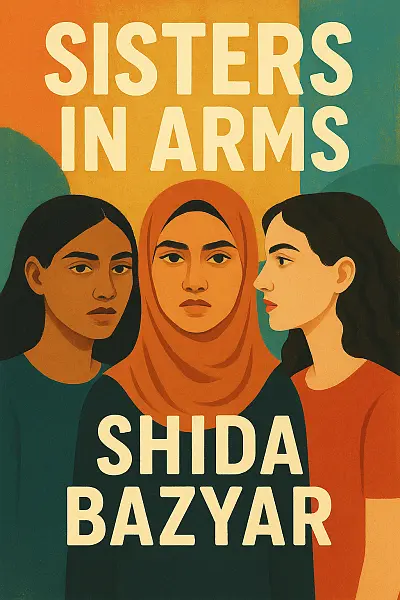
Sisters in Arms
by: Shida Bazyar
Hani, Kasih, and Saya reunite in contemporary Germany, each hoping to rekindle the unbreakable bond that once anchored their lives. Thriving in their own ways but shadowed by daily racism, they find stability in each other’s friendship, a kind of armor against a world that won’t quite accept them.
But when a shocking act of right-wing terror crashes into their brief reunion, the emotional stakes skyrocket—suddenly, everything feels fragile. The trio must confront not only external hatred but also their own fears: can their sisterhood withstand this pressure, or will society’s cruelty break them apart?
Written in a sharp, intimate style, Sisters in Arms pulses with urgency and hope—it’s a heart-to-heart about belonging in a world determined to exclude you.
"In a world eager to divide us, resistance is born in the quiet decision to stand together."
Let's Break This Down
The Author's Voice
Atmosphere
- Raw, immediate, and unflinching—Bazyar places you right in the emotional trenches with her characters.
- There's a constant tension, almost claustrophobic at times, balancing between the oppressive weight of societal forces and the intimate comfort (and conflict) of friendship.
- Expect moments that feel charged and restless—every scene hums with a quiet urgency, whether in mundane routines or bursts of confrontation.
Prose Style
- Direct, vivid, and fiercely personal. Bazyar’s voice feels conversational yet sharp, sometimes sliding into abrupt, staccato rhythms that echo her characters’ anxieties.
- Dialogue crackles with realism—raw and sometimes biting, with little polish, making every exchange feel authentic, even when uncomfortable.
- There’s a clever undercurrent of irony and dark humor woven through, lending bite to the weightier moments without undermining their seriousness.
Pacing
- Bazyar takes her time building interiority and relationships—the tempo leans contemplative, even meditative, at first.
- The narrative can ebb and flow: slower introspective segments give way to tense, quicker sequences when conflict heightens or memories resurface.
- Don’t expect a traditional thrill-ride: instead, the pacing mirrors the rhythms of everyday life interrupted by larger, more dangerous realities.
Overall Rhythm & Feel
- The writing radiates urgency and empathy, constantly oscillating between moments of vulnerability and fiery resistance.
- You’ll notice seamless shifts in perspective that keep you on your toes, reflecting the unsettled world Bazyar is portraying.
- If you crave fiction that’s honest, challenging, and a little rough around the edges, “Sisters in Arms” will feel like exactly the kind of immersion you’ve been waiting for—gritty, real, and impossible to ignore.
Key Moments
- Three women, one spark—friendship forged in the fires of Hamburg’s racial tensions
- Electric prose crackles as secrets spill during a midnight rooftop confession
- Protest marches pulse through the pages—fear, hope, and fury in every heartbeat
- Raw, stinging reflections on outsiderhood—what it means to be “the other” in your own home
- A breathtaking face-off with the police—anxiety dialed up to eleven
- Snapshots of sisterhood: inside jokes, silent support, and brutal honesty
- Final pages linger with a bruised hope—proud, imperfect, unbreakable resilience
Plot Summary
Sisters in Arms by Shida Bazyar follows the intertwined lives of three friends—Hani, Kasih, and Saya—young women of immigrant backgrounds living in contemporary Germany. The story kicks off with a fire in their apartment building, which sets off suspicions and media intrigue, tangibly affecting the trio. As the friends are increasingly scrutinized by both authorities and society, their solidarity is tested; secrets emerge, old tensions resurface, and the pressure mounts, culminating in a dramatic public confrontation that forces each woman to confront what loyalty, identity, and resistance mean to her. By the end, the friends must grapple with both the tragedy in their building and the fallout of public suspicion—ultimately choosing to reclaim their own narrative rather than being defined by others.
Character Analysis
- Hani is the pragmatic peacekeeper of the group, often torn between her drive to fit in and her fierce loyalty to her friends; throughout the novel, her character wrestles with her need for acceptance versus solidarity.
- Kasih is passionate and outspoken, quick to resist injustice but also vulnerable, particularly when her family’s past trauma is brought under scrutiny; her arc is shaped by her growing realization that anger can be both a weapon and a shield.
- Saya is the most introspective, using humor and cynicism to mask her deeper insecurities; her journey is about learning to trust not only others but her own sense of agency as a marginalized woman.
By the final chapters, all three have changed—more aware of both their inner strengths and of the costs required to stand together against a hostile environment.
Major Themes
- Solidarity and Friendship: The novel’s heart lies in its portrayal of female friendship under immense societal pressure, especially for women of color, as seen in their efforts to protect each other during the media frenzy.
- Otherness and Belonging: Bazyar vividly explores what it means to always feel like an outsider—systemic racism, xenophobia, and the subtle violence of questions like “where are you really from?” all play significant roles, especially after the fire when suspicion falls swiftly on the trio.
- Media and Narrative: The story also investigates how the media shapes public perception, often misrepresenting or vilifying marginalized groups, which is directly reflected in how the protagonists are treated and how they ultimately choose to tell their own story.
This triple focus on belonging, resistance, and the power of naming cements the book’s central message: self-definition is an act of radical courage.
Literary Techniques & Style
Bazyar uses a polyphonic narrative structure, granting each woman a distinct voice and perspective, which deepens our understanding of their individual and collective struggles. The writing is lyrical and incisive, blending dry humor with moments of raw vulnerability—an approach that makes heavy topics accessible without diminishing their weight. Symbolism recurs throughout: the fire stands as a metaphor for the destructive scrutiny of society, while repeated motifs around doors and thresholds echo themes of inclusion and exclusion. Bazyar’s deliberate use of code-switching and fragments of dialogue in multiple languages subtly underscores the fractured experience of second-generation immigrants.
Historical/Cultural Context
Set in present-day Germany, Sisters in Arms is deeply rooted in the realities of post-migrant society, where issues of racism, integration, and national identity are fiercely debated. The novel references real-life incidents of far-right violence and the ways institutional bias affects both personal and collective lives. This backdrop grounds the characters’ experiences, with Bazyar drawing on her own experiences as the child of Iranian refugees to inject authenticity and urgency.
Critical Significance & Impact
Sisters in Arms has been widely praised in German literary circles for its unflinching look at racism, female solidarity, and media complicity. It’s seen as a vital addition to contemporary German literature, opening up conversations about intersectionality, identity, and who gets to own the narrative in a multicultural society. The book’s blend of intimate storytelling and sharp social critique makes it especially relevant for today’s readers—inviting empathy, self-reflection, and, hopefully, change.
Defiance and friendship ignite in a radical portrait of resistance.
What Readers Are Saying
Right for You If
If you’re into books that really dig into friendship, identity, and what it means to belong, Sisters in Arms should definitely be on your radar. You’ll get the most out of this one if you love stories that blend political themes with genuine personal moments—think real talk about race, family, and finding your place in a complicated world.
Who’s going to love this book?
- Fans of literary fiction—especially those drawn to character-driven stories over wild, twisty plots.
- If you crave fresh perspectives and voices that don’t shy away from the tough stuff like discrimination or cultural identity, this one’s for you.
- Anyone into books with a vibe similar to Brit Bennett, Yaa Gyasi, or Zadie Smith—there are definite echoes you’ll appreciate.
- Readers looking for complicated female friendships (the messy, deep, honest kind) will totally connect with the characters here.
- If you love novels that raise way more questions than neat answers—basically, books that make you think—this will hit the spot.
Who might want to skip it?
- If you need a plot-heavy read with thrilling twists or fast-paced action, this might feel a bit slow for you—it’s definitely more about the journey than the destination.
- Anyone hoping for a light, feel-good escape or books that wrap up with everything tied in a bow may want to keep looking—this one leans into the messy realities and doesn’t offer easy solutions.
- Readers who prefer very straightforward storytelling and aren’t into books with shifting timelines or perspectives might find the structure a little tricky.
Bottom line:
If you love stories that make you feel and think, and you appreciate honest, sometimes uncomfortable explorations of real issues, you’ll probably be recommending this one yourself. If you’re just looking for an easy, breezy read, you might want to save it for another time.
What You're Getting Into
Get ready for an unforgettable ride with Sisters in Arms by Shida Bazyar!
Three close friends—Hazal, Saya, and Kasih—navigate the challenges of young adulthood in contemporary Germany, where the weight of prejudice, loyalty, and family history looms over every decision. As tensions rise both inside and outside their circle, their unbreakable bond is tested by events that force them to confront what it truly means to stand together. Electric, raw, and fiercely real, this novel pulses with a gripping blend of solidarity, rebellion, and survival.
Characters You'll Meet
-
Saray: Acts as the defiant and passionate force among the friends, often pushing boundaries and challenging societal expectations. Her rebellious spirit drives much of the group’s dynamic and motivates critical moments in the story.
-
Hani: The thoughtful, introspective member who grapples with her identity and family expectations. Her journey is central to the novel's exploration of belonging and internal conflict.
-
Kasih: Provides a voice of cautious pragmatism, frequently caught between loyalty to her friends and desire for personal stability. Her evolving perspective underscores the complexities of navigating friendship and ambition.
-
Shaima: Grounds the group with her calm, steady presence, often serving as a mediator during conflicts. She’s a quiet pillar of support whose personal growth shines subtly through the narrative.
More Like This
You know that bittersweet, electric energy running through The Hate U Give by Angie Thomas? Sisters in Arms taps into the same urgency, confronting issues of race, identity, and solidarity among young women pushed to the edge by a society that refuses to see them. There’s an emotional rawness here—one that calls to mind Girl, Woman, Other by Bernardine Evaristo. Both novels intricately weave together the inner lives of their central characters, offering a chorus of voices that challenge and uplift, navigating the complexities of intersectionality with fierce honesty and empathy.
If TV’s more your thing, there’s a striking parallel to the series I May Destroy You. Much like Michaela Coel’s fearless storytelling, Bazyar doesn’t shy away from uncomfortable truths, exploring trauma, resistance, and friendship with a deeply intimate perspective. The show’s blend of dark humor and razor-sharp social commentary finds a kindred spirit in this novel, making Sisters in Arms a gripping choice for anyone drawn to stories that are unflinching and unapologetically real.
Critic's Corner
What if solidarity is both a rebellion and a lifeline? Shida Bazyar’s Sisters in Arms startles us into asking how deep-rooted friendships can survive—maybe even defy—the relentless grind of racism and alienation. As Hani, Kasih, and Saya, caught between belonging and otherness, circle back to each other, Bazyar doesn’t just chronicle experiences; she challenges us to sit uncomfortably with what it means to be “seen” or—more chillingly—not seen at all.
Bazyar’s prose is alive: raw, clear-edged, and unflinching. The language brims with directness—almost confrontational in its honesty—but always pulses with warmth when the women connect. She slips with agility between internal monologues, staccato dialogue, and sharply observed social commentary. Moments of lyricism surface in surprising places, often undercut by a biting, satirical humor—think swift, almost breathless sentences packed with urgency.
What stands out is voice: the friends feel distinct but entangled, their perspectives sometimes overlapping, other times clashing—echoing the realities of deep, complex kinship. Bazyar embraces fragmentation; nonlinear memory threads tangle with the present, creating a narrative as jumpy and unpredictable as memory itself. While this bold stylistic choice immerses us in the women’s emotional states, it can, at times, muddle pacing—occasionally, the narrative feels on the verge of spinning out, mirroring the instability the characters endure.
The heart of the novel throbs with the ache of exclusion and the fierce beauty of chosen family. Bazyar interrogates power, visibility, and the violence lurking in everyday encounters—not with didacticism, but by nailing the texture of microaggressions, the looming dread, and the exhaustion of being persistently othered. Friendship here is not just comfort; it’s resistance, a radical act in the face of systems that refuse to acknowledge these women as fully real.
Yet, the book’s most incisive philosophical move is to recognize how even the safest alliances can buckle under pressure. Bazyar is relentless in exploring tension—not just between her heroines and society, but also among the friends themselves as past grievances, present fears, and future anxieties collide.
In this climate—where anti-racist and feminist activism is both celebrated and contested—Sisters in Arms matters deeply. It cracks open the easy narratives of resilience, demanding that we pay attention to the cost of survival in an unwelcoming world.
Within the canon of feminist and anti-racist literature, Bazyar’s work feels urgent and necessary—inviting comparison to authors like Chimamanda Ngozi Adichie and Nadine Gordimer, yet fiercely its own. She spins German social realities and the immigrant experience into a story that is both unmistakably contemporary and timelessly human, pushing the tradition of the political novel toward something more visceral, more fragmented, more real.
If Sisters in Arms has a flaw, it’s that its deliberate disjointedness and emotional intensity occasionally threaten to overwhelm reader orientation. Still, Bazyar’s artistry and the force of her vision more than compensate. This novel isn’t always comfortable, but it’s undeniably vital—a heartbreakingly honest, gripping testament to the transforming power of solidarity.
Community Thoughts
so there's this SCENE where Noor just stands her ground, and for a second I forgot to breathe. I kept replaying her words in my head all night. sisters in arms hits hard in the quietest moments.
I still hear Hani’s voice in my head. Her anger and hope twined together made me question everything. Couldn't shake it, even days later. Hani’s stubborn fire haunts the quietest moments.
honestly, i was NOT prepared for how Hani’s rage would linger in my mind. every time she entered a scene, the tension skyrocketed. couldn’t stop thinking about her after i finished.
so i stayed up way too late thinking about Yael, like, how does a character get under your skin like that? seriously, her anger and hope tangled up just would not let me sleep.
Waking up at 3am thinking about Hani’s fierce stubbornness, I realized this book had invaded my dreams. Her rage and hope tangled up in my head, refusing to let me go. Sleepless but grateful for it.
Leave Your Review
Local Take
Why It Matters
Sisters in Arms by Shida Bazyar strikes a real chord in Germany, especially given the country's ongoing conversations about immigration, integration, and the complexities of identity.
- The novel’s exploration of second-generation immigrant experiences echoes Germany’s Gastarbeiter history and the growing visibility of post-migrant literature. It invites parallels with recent social movements like #MeTwo and ongoing activism around racism and belonging.
- The characters’ struggles with systemic discrimination and solidarity resonate with Germany’s increasing focus on diversity, but can also generate friction against more traditional cultural values about assimilation and “Germanness.”
- Certain plot points—a sense of always being “on the outside,” or the reality of microaggressions—really hit home for readers here, validating experiences rarely voiced in older German literature.
- The narrative directly challenges the often understated style of German literary tradition, opting instead for a raw, urgent voice; that echoes contemporary German works like those by Şeyda Kurt or Olga Grjasnowa, building on but also pushing against what mainstream literature typically explores.
In short? It’s bold, timely, and sparks real conversations that feel both overdue and necessary in the German context.
Food for Thought
Notable Achievement:
Sisters in Arms by Shida Bazyar has been celebrated for its powerful portrayal of friendship, racism, and resistance, earning a spot on the longlist for the Deutscher Buchpreis. The novel has sparked passionate conversations in Germany for its raw, honest exploration of second-generation immigrant experiences and has become a talking point among younger readers seeking more diverse voices in German literature.
Like what you see? Share it with other readers