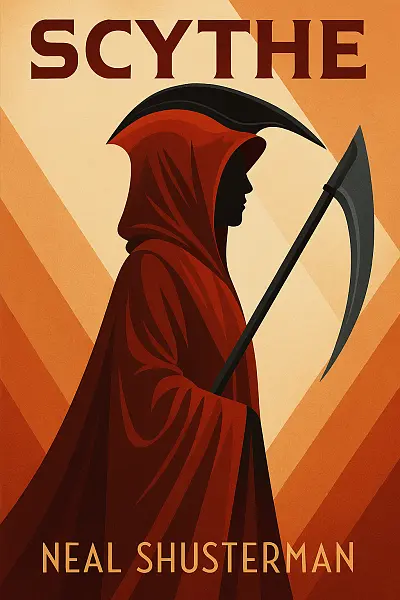
Scythe
by: Neal Shusterman
Citra and Rowan live in a perfect world where death is obsolete, and only scythes can end lives to keep population in check. Neither teen wants this brutal responsibility, but when they're unexpectedly chosen as scythe apprentices, their world flips upside-down. Suddenly, they're pitted against each other, forced to master the art of killing or lose everything—including their own lives.
As the pressure mounts, both struggle with the cost of compassion versus duty, wrestling with their own morals and each other. The story's sharp, emotionally charged narrative grabs you, always keeping you teetering on "will they or won’t they" brink.
""When mercy is measured and death deliberate, the weight of humanity rests on every choice.""
Let's Break This Down
The Author's Voice
Atmosphere
Darkly gleaming and chillingly plausible, the world of Scythe hums with a sense of uneasy perfection. Shusterman crafts an uncanny setting—sleek, sterile, and disturbing—where immortality is normal but the specter of death still lingers. Every scene pulses with tension, making you feel the weight of each character’s choices in a chilling, hyper-controlled society that’s both utopian and deeply unsettling.
Prose Style
Shusterman’s writing is crisp, direct, and completely unpretentious. He avoids flowery language, opting instead for clear, cinematic sentences that keep you grounded in the moment. Dialogues are sharp and often edged with irony, while introspective passages offer just enough depth to invite thought without disrupting the story’s momentum.
Pacing
The pace is a perfect mix of steady build-up and gripping momentum. Shusterman balances world-building with action, delivering plot twists right when your curiosity peaks. Chapters tend to end on irresistible notes, making it far too easy to promise yourself “just one more.” There’s a real sense of forward drive—even in quieter scenes, the tension simmers, keeping you glued to the page.
Character Development
Characters are believably flawed, constantly evolving, and never stagnant. Citra and Rowan each navigate moral dilemmas and inner turmoil that feel raw and immediate. Shusterman smartly avoids clichés, letting his protagonists grow through hard-won realizations. Even supporting characters have surprising depth and motivation.
Themes & Tone
Expect some big, thought-provoking questions—What does it mean to live forever? Who decides who should die? The tone is deep but never preachy; it nudges you to ponder ethics, humanity, and power without slowing the adventure. There’s a thread of dark humor that undercuts the dystopian gloom, just enough to keep things from getting heavy-handed.
Overall Feel
Scythe practically crackles with intellectual energy and high-stakes drama. Think: shock, adrenaline, and existential brain food, all delivered in a sleek, accessible package. If you love stories that blend thriller-suspense with genuine moral dilemmas and a sharply original setting, you’re in for a ride.
Key Moments
-
"A world where death comes only by Scythe—chillingly original concept that flips mortality on its head"
-
Citra and Rowan’s reluctant rivalry—training with an edge-of-your-seat, life-or-death twist
-
Thunderhead’s omniscience vs. terrifying human loopholes—ethics explored in every crisp chapter
-
The gleaning at Kohl’s party—full-body chills, raw fear, and a pivotal turn for both protagonists
-
Scythe Curie’s haunted mentoring—wisdom pressed between lines of regret and resolve
-
High-stakes conclave: backstabbing politics in vividly imagined crimson robes
-
That gut-punch final showdown—loyalties tested and an audacious gambit that redefines mercy
Plot Summary
Scythe thrusts us into a futuristic world where death has been conquered and a select group, the Scythes, are tasked with population control through "gleaning." Teenagers Citra and Rowan are reluctantly chosen as Scythe Faraday’s apprentices, drawn into the arcane world of mortality. When the Scythedom splits between old-guard Scythes (who kill mercifully) and New Order Scythes (who kill for pleasure), Citra and Rowan are pitted against each other in a deadly test—only one can win the ring and the other must die. The climax builds as Citra narrowly wins her trials, but spares Rowan, helping him escape the corrupt system. By the end, Rowan becomes the vigilante "Scythe Lucifer," seeking justice from within, while Citra carries the burden of her new role as Scythe Anastasia.
Character Analysis
Citra Terranova is clever, stubborn, and driven by a strong moral code; she evolves from questioning the system to trying to reform it from within, eventually embracing the gravity of her role as Scythe Anastasia. Rowan Damisch begins as insecure but idealistic, growing bolder and more rebellious as he witnesses the cruelty and corruption in the Scythedom, culminating in his transformation into Scythe Lucifer. Scythe Faraday serves as a wise but conflicted mentor who tries to instill compassion in his apprentices, while Scythe Goddard embodies the New Order’s excess and sadism. Together, their arcs reflect a spectrum of responses to power, mortality, and ethical leadership.
Major Themes
One central theme is the nature of mortality and the value of life—in a deathless society, the Scythes' role forces characters and readers alike to consider what gives life meaning. Corruption and power run rampant in the Scythedom, with factions debating the purpose behind gleaning; Goddard’s manipulation exposes how easily noble intentions can decay. There's also a strong undercurrent of individual morality versus institutional duty, particularly as Citra and Rowan question rules and carve their own paths. Evolving definitions of justice and mercy shape both the plot and the world’s philosophy, illustrated by the apprentices’ choices during their final test.
Literary Techniques & Style
Neal Shusterman writes in a crisp, cinematic style, blending swift pacing with moments of philosophical rumination. Alternating third-person perspectives keep readers close to both Citra and Rowan’s inner journeys, while excerpts from Scythe journals inject world-building and moral questioning directly into the narrative. Symbolism abounds—the act of gleaning, the scythe rings, and even names (like Anastasia and Lucifer) reinforce the story’s larger questions about death and legacy. Subtle irony and occasional dark humor deepen the intrigue, while scenes of violence are described with both clinical detachment and emotional resonance to emphasize the surreal horror of normalized death.
Historical/Cultural Context
Set in a distant future where AI (the Thunderhead) has solved humanity’s major problems, Scythe explores a post-scarcity, post-mortality society. The story riffs on contemporary debates over euthanasia, surveillance, governance, and ethical technology, reimagined in a world that’s utopian on the surface but dystopian underneath. In many ways, the novel mirrors current anxieties about unchecked authority and the consequences of removing natural limits from human experience.
Critical Significance & Impact
Scythe has been celebrated for revitalizing dystopian YA with its fresh premise and moral complexity, quickly becoming a classroom and book club staple. Critics and readers alike appreciate its willingness to grapple with big questions—about death, governance, and what it means to be good—in a genre that often simplifies moral choices. Its blend of philosophical depth and page-turning suspense marks it as both thought-provoking and wildly readable, ensuring enduring relevance for students and genre fans alike.

When life is sacred, death becomes an art—wielded by reluctant hands.
What Readers Are Saying
Right for You If
If you’re into dystopian worlds with a wickedly cool twist, Scythe is totally your jam. Seriously, fans of The Hunger Games, Divergent, or The Maze Runner will feel right at home here—there’s all the high-stakes action, big philosophical questions, and a dash of moral messiness that’ll keep you guessing.
- Love a bit of dark humor, inventive world-building, and characters you can actually root for (or love to hate)? You’ll be flipping pages WAY past your bedtime.
- Enjoy books that make you pause and think about big stuff—life, death, ethics, all that deep stuff—but without getting preachy? This one nails it.
- YA readers, sci-fi & fantasy fans, and anyone who likes plots that move: it’s a sweet mix of fast-paced and though-provoking.
But hey, if you’re after something super light and fluffy or you need romance front-and-center, maybe skip this one. Also, if you don’t love exploring gray moral areas or you get squeamish about topics like mortality and death (it’s sort of a big deal here), this might not be your vibe.
So: if you’re cool with a little darkness and love grappling with what it means to be human—even when humans are basically immortal—Scythe could be your next obsession!
What You're Getting Into
Imagine a world that’s conquered death, where the only way to die is at the hands of a "Scythe" — elite individuals tasked with population control.
Citra and Rowan, two teens from wildly different backgrounds, are unexpectedly chosen to apprentice under a Scythe, thrusting them into a morally charged, high-stakes world where every choice could cost lives or futures.
If you’re into thought-provoking dystopias, razor-sharp suspense, and unforgettable moral dilemmas, Scythe delivers a wild ride you’ll be itching to discuss long after you turn the last page!
Characters You'll Meet
-
Citra Terranova: Resourceful and compassionate, Citra is chosen as a scythe apprentice and fiercely questions the morality of gleaning. Her growth as she navigates the ethics and consequences of death anchors the heart of the story.
-
Rowan Damisch: A thoughtful underdog, Rowan is thrust into the competitive world of scythehood alongside Citra. His gradual disillusionment and inner conflict as he’s shaped by darker forces drive much of the plot’s tension.
-
Scythe Faraday: Wise and principled, Faraday mentors both Citra and Rowan, emphasizing respect for life. His guidance and secrecy about his own motives add depth to the apprenticeship arc.
-
Scythe Curie: Known as the “Grande Dame of Death,” Curie is revered and enigmatic, championing mercy amid ruthlessness. Her mentorship, especially of Citra, adds a moral dimension and complicates the scythe world’s politics.
-
Scythe Goddard: Charismatic and manipulative, Goddard embodies the darker, excess-driven side of the Scythedom. His extreme beliefs and actions cause major upheaval, challenging the values of both protagonists.
More Like This
If the chilling examination of society’s rules in The Hunger Games kept you glued to the page, you’ll find Scythe equally gripping. Both novels drop readers into worlds where youth must grapple with mortality and impossible morality, but where The Hunger Games revels in rebellion, Scythe obsesses over the ethics of life and death itself—imagine the tension dialed up with a philosophical twist.
Fans of Divergent will recognize the intense rite-of-passage structure as Citra and Rowan are thrust into training and competition; Scythe builds a world that tests not only physical mettle but sharpens its focus on the choices that define a person—driving you to question what you’d do in their shoes.
For those who love immersive, thought-provoking visual storytelling, the DNA of Black Mirror is unmistakable here. Shusterman’s world, like the show, asks: What happens when technology perfects life, but we, as humans, still have to decide who dies? The haunting, futuristic atmosphere evokes Black Mirror’s speculative anxieties, yet Scythe adds its own flavor by stirring in heart and deeply personal stakes.
Critic's Corner
What happens when society solves death, but must legislate morality? Scythe dares to envision a world where immortality breeds not euphoria, but existential bureaucracy. Neal Shusterman throws readers into an unsettling utopia that asks: If mortality vanishes, what meaning remains for life—or justice? It's a premise as chilling as it is thought-provoking, challenging our assumptions about progress, empathy, and the soul's cost.
Craft analysis:
Shusterman's writing is crisp, kinetic, and unapologetically direct—his prose flows with a purposeful simplicity that makes complex themes accessible, especially to a teen audience. There’s a cinematic urgency to the scenes, with short chapters and shifting perspectives efficiently maintaining tension. The narration wields a cool detachment that mirrors the stoic ethos of the Scythedom, lending weight to moments of moral ambiguity. Dialogue is deftly handled, at times almost brittle, refusing melodrama in favor of understated intensity—a smart fit for characters wrestling with suppressed guilt and reluctant violence. Occasionally, the narrative voice leans heavily into exposition, especially in the journal entries that frame each section; while these provide grounding, they sometimes risk telling rather than showing. Still, Shusterman’s command of structure—alternating between Citra and Rowan—enriches both pacing and emotional stakes, keeping readers oscillating between hope and dread.
Thematic depth:
At its heart, Scythe is a meditation on the burden of agency when consequence is revoked. With no war, illness, or natural death left to fear, what is the value of living well, or dying at all? Shusterman’s “scythes” are both executioners and reluctant philosophers, forced to weigh compassion against a statistical coldness. The apprentices’ journey probes ethical gray zones: does power inevitably corrupt? Can empathy survive when institutionalized violence is normalized? In the age of technology, where algorithms promise perfection, Scythe responds with unsettling questions about human oversight, equity, and mercy. In our current cultural climate—obsessed with longevity, technocratic promises, and the atomization of responsibility—this book feels especially urgent. It invites young and adult readers alike to grapple with the cost of painless futures and whether true justice can be systematized.
Comparative context:
Within YA dystopia, Scythe stands apart: where Divergent and The Hunger Games foreground revolution, Shusterman opts for moral evolution, exploring consequences long after the “victory” over death. His tonal restraint and philosophical ambition align more with Lois Lowry’s The Giver or even Atwood’s speculative fables than the hyperkinetic angst of standard genre fare. For readers familiar with Shusterman’s Unwind series, this is a confident maturation—leaner, sharper, and far more intellectually provocative.
Critical assessment:
Not every metaphor lands cleanly, and some supporting characters are finely etched while others blur into archetype. Still, Scythe succeeds wildly at making weighty ideas both thrilling and deeply personal. Shusterman’s taut, elegant storytelling offers a rare, memorable blend of moral urgency and narrative momentum—a must-read for thoughtful fans of speculative fiction.
Community Thoughts
Rowan’s journey absolutely scrambled my brain, I kept thinking about his choices at 2 AM instead of sleeping. Who knew a book about death could hijack your routine like this? Shusterman, you wizard.
Citra’s determination absolutely haunted me. Her struggle between compassion and duty kept me up thinking about what choices I’d make. Shusterman crafted a character who lingers in your mind long after the last page.
i legit couldn’t stop thinking about scythe goddard, he’s the villain but so charismatic it’s almost disturbing. why do i like reading about someone so twisted? this book made me question my own taste in characters.
I wasn’t ready for the way Citra’s determination just stuck in my head. That girl haunted me long after I finished. Her choices, her grit, I kept replaying them. Seriously, she’s impossible to forget.
i wasn’t ready for how Scythe made me question everything about mortality. Rowan’s journey haunted my dreams and now i can’t stop pondering what it means to really live when death is controlled. Shusterman, you broke my brain.
Leave Your Review
Local Take
Why It Matters
Scythe by Neal Shusterman strikes a chord with English-speaking readers, especially in countries like the US or UK, where individual rights, personal agency, and skepticism toward authority are deeply valued.
-
The book’s premise—a future without natural death, governed by a powerful, morally ambiguous Scythedom—mirrors real-life debates on government overreach and the ethics of life-and-death decisions (think the ongoing discussions about healthcare, capital punishment, or even data privacy). The tension between Citra and Rowan’s morality and the system feels familiar to anyone who’s watched whistleblowers or dissidents challenge the status quo.
-
Themes of free will, corruption, and the responsibility that comes with power echo classic British dystopias (Orwell’s 1984, Huxley’s Brave New World), but with a YA twist—making it super accessible.
-
American readers, raised on narratives glorifying rebellion against tyranny, might find themselves especially drawn to the characters’ struggle to retain their humanity. Moments of resistance and defiance hit hard in cultures that prize individualism.
-
Yet, the book’s questioning of bureaucratic immortality might clash with more collectivist cultural values, making it spark some great debates in multicultural classrooms.
So, if you love stories that nudge you to think about power, ethics, and the cost of utopias—Scythe resonates in ways both familiar and thought-provoking within English-speaking cultures!
Food for Thought
Notable Achievement:
Scythe by Neal Shusterman won the 2017 Michael L. Printz Honor for excellence in young adult literature and has sparked massive interest in dystopian fiction, building a dedicated fanbase and inspiring discussions on morality and the value of life.
Like what you see? Share it with other readers