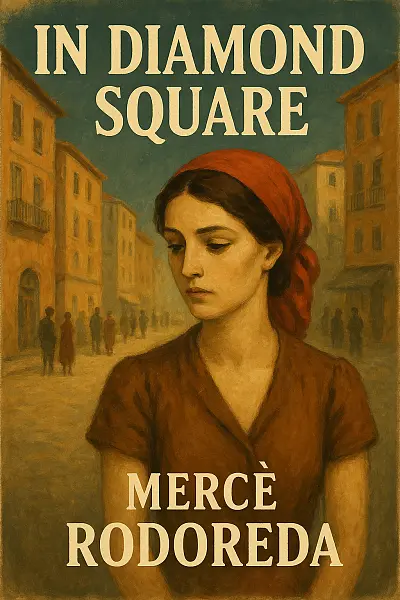
In Diamond Square
by: Mercè Rodoreda
Natalia is a timid shop-girl in 1930s Barcelona, just trying to get by when a charming stranger, Joe, sweeps her onto the dance floor at the bustling Diamond Square festival. Despite her doubts, Natalia marries him, hoping for happiness—but reality quickly complicates things as Joe’s pigeon-breeding dreams fill their modest flat and test her patience.
Then, the Spanish Civil War shatters any sense of normalcy. With Joe off fighting, Natalia is left to scrape together food and hope for her children as their world unravels.
Rodoreda’s prose is beautifully spare, capturing every raw emotion as Natalia clings to dignity, love, and survival in a city under siege. Will she endure, or be broken by fate’s relentless blows?
"“In the quiet ache between joy and loss, we remember that survival is its own kind of courage.”"
Let's Break This Down
The Author's Voice
Atmosphere
- Gritty realism meets understated lyricism. The book wraps you in the claustrophobic, sun-bleached streets of pre–civil war Barcelona, where tensions simmer quietly beneath daily routines.
- There's a constant sense of austerity; hope flickers like a candle in a drafty room. Rodoreda conjures domestic detail and period atmosphere with just a few spare strokes, creating a world that feels lived-in yet utterly fragile.
Prose Style
- Plainspoken, but deeply evocative. Rodoreda's sentences are short and direct, almost deceptively simple—yet every word is packed with feeling.
- Dialogue is sparse and internal monologue dominates, letting you live inside Natalia's head. The language often has a breathless, confiding quality, making you feel like a trusted friend.
- There’s poetry in the minimalism. The style doesn’t dazzle with literary flourishes, but it stings quietly with emotional insight.
Pacing
- Deliberately measured. The narrative flows in swift, fragmentary bursts—reflecting how the protagonist experiences her life, moment to moment.
- Expect passages where time seems to slow, lingering on small, repetitive details, interspersed with sudden jumps that convey major life changes almost offhandedly.
- This stop-start rhythm draws you deep into the psychological landscape, rather than urging you quickly through the plot.
Overall Mood & Feel
- The tone is intimate, raw, and heartbreakingly restrained. Even at its most bleak, the writing hums with a kind of reluctant tenderness.
- If you love character-driven fiction that trades overt drama for emotional granularity and subtlety, this book’s style will pull you in quietly and keep you under its spell.
Key Moments
- War-torn Barcelona bleeding through every page
- Colometa’s silent despair echoing in cramped, sunlit rooms
- A pigeon coop becomes a haunting symbol of lost innocence
- Raw, minimalist prose cutting straight to the bone
- Stomach-twisting moments of hunger and desperation
- A quietly shattering scene with flour, death, and hope all mingling in the kitchen
- Love and survival locked in a dance, always one step from heartbreak
Plot Summary
In Diamond Square follows the life of Natàlia, an ordinary young woman in Barcelona on the verge of the Spanish Civil War. She meets and marries Quimet, and together they face growing hardships, jealousy, and the trials of parenthood amidst economic struggle. The war shatters their already fragile existence: Quimet is drafted and, ultimately, killed, leaving Natàlia alone to support her two children. Worn down by poverty and the emotional devastation of war, she finds moments of solace in small joys, surviving and remarrying with the carpenter, Antoni. The novel ends with Natàlia wandering the titular Plaça del Diamant, reflecting on all she has lost and the resilience she has forged.
Character Analysis
Natàlia (also called Colometa) is the novel’s steadfast heart: starting as a shy, naive girl, she’s swept along by the strong-willed Quimet's demands, gradually transforming into a resilient, resourceful woman forced by circumstance to assume control over her fate. Quimet himself is a compelling yet often toxic presence—his possessiveness and pride create much of Natàlia's misery, yet he is not merely a villain but a tragic product of his environment and the era’s expectations. The supporting cast—especially figures like Antoni, who represents safety and pragmatism—mirror the shifting tides of Natàlia’s hope and despair, highlighting her quiet but powerful growth.
Major Themes
The loss of innocence and the burden of survival are front and center, as Natàlia's journey mirrors the descent of a country into chaos. Rodoreda explores the crushing effects of patriarchy and war on individual lives, particularly that of women left behind, using Natàlia’s story to illuminate the everyday heroism required merely to endure. Alienation, trauma, and the slow grind of poverty are rendered vividly through Natàlia’s perspective; her small acts of resistance and resourcefulness show the persistence of hope even when society—and personal relationships—fail her. The recurring motif of doves reflects both the confining nature of domestic life and the longing for freedom.
Literary Techniques & Style
Rodoreda’s style is intimate and immediate, employing a first-person stream-of-consciousness narration that plunges readers directly into Natàlia’s mind—her fears, moments of dull acceptance, flickers of happiness, and deep loneliness. The language is simple yet poetic, packed with intense symbolism, especially in the recurring images of doves (representing innocence, burden, and entrapment) and the eponymous diamond square, which stands as a symbol of her hopes and disappointments. The narrative unfolds episodically, with shifting chronology and memory gaps, mirroring how trauma distorts experience and time. Rodoreda uses metaphor and understated prose to evoke complex emotions, letting unspoken pain saturate the text.
Historical/Cultural Context
Set in Barcelona from the 1920s through the aftermath of the Spanish Civil War, the novel captures the upheaval and daily hardship faced by ordinary citizens—especially women—during these turbulent years. Social norms, gender expectations, and the brutal effects of the war deeply shape the characters’ choices and destinies. Rodoreda draws extensively on Catalan culture and working-class struggles, offering an authentic, ground-level portrait of life under Francoist repression and during times when survival felt revolutionary.
Critical Significance & Impact
In Diamond Square is widely celebrated as a masterpiece of Spanish and Catalan literature, praised for its psychological depth and devastating portrayal of war’s collateral damage. Its intimate depiction of female resilience in the face of overwhelming adversity has cemented its status as a classic, resonating with readers across generations and cultures. The novel’s popularity and critical acclaim have fueled renewed discussions about women’s experiences in wartime, memory, and the power of understated storytelling.

A woman's survival reshaped by war—Barcelona's soul in every page
What Readers Are Saying
Right for You If
If you’re someone who loves deeply emotional stories set against the backdrop of real history, In Diamond Square is totally your vibe. Fans of character-driven novels, especially those who get swept up in the nuanced inner worlds of ordinary people, will really connect with this one. If books like A Tree Grows in Brooklyn or Suite Française are your jam, there’s a good chance you’ll find yourself glued to this.
This one’s also perfect for anyone who’s interested in women’s voices and perspectives that don’t often take center stage—Natalia’s journey through war, love, and hardship is both understated and powerful. Oh, and if you love immersive settings and prose that feels both poetic and honest, you’re honestly going to eat this up.
Now, heads up—if you’re looking for fast-paced action or a plot packed with big twists, you might want to pass. This isn’t a thriller, and the drama is more about the internal than the external. Readers who struggle with introspective books or want a “feel-good” read might find it a little heavy or slow. And if you need a neat, cheerful ending, prepare yourself—this one goes for emotional honesty over tidy resolutions.
So, definitely scoop this up if you’re into literary fiction, historical novels, and gorgeous, subtle writing, but maybe skip it if you want a light read or non-stop action. Think of it like a quiet evening in with a cup of tea: it’s gentle, wise, and quietly devastating in all the best ways.
What You're Getting Into
Set in pre–Civil War Barcelona, In Diamond Square follows the ordinary yet quietly extraordinary life of Natalia, a young woman swept into marriage and motherhood amid political unrest. Her personal struggles mirror the turmoil of a city in upheaval, as she finds herself caught between duty, love, and survival. With a raw, emotional vibe, this intimate portrait explores how one woman's resilience is tested by both the demands of her own heart and the world falling apart around her.
Characters You'll Meet
-
Natalia (Colometa): The heartfelt protagonist whose emotional resilience is tested by poverty, loss, and war. Her journey from naive young bride to scarred survivor anchors the entire story.
-
Quimet: Natalia’s passionate but domineering husband. His idealism and controlling nature shape the family’s fate and much of Natalia’s struggle.
-
Senyor Cintet: A practical and trustworthy friend of Quimet and Natalia. He offers rare moments of stability and occasional comic relief against the bleakness of their lives.
-
Pere: Natalia’s gentle second husband, representing a stark contrast to Quimet. With his kindness and simplicity, he helps Natalia rediscover moments of peace.
-
Julieta: A strong-willed friend to Natalia, providing support and advice as she faces personal and historical turmoil.
More Like This
If you've ever been captivated by the emotional intensity and quiet power of The Diary of Anne Frank, you'll find In Diamond Square emanates a similar sense of personal upheaval set against the turbulence of war. Both immerse readers in the world of one woman coping with forces far beyond her control, offering an intimate window into survival and resilience. At the same time, Rodoreda’s lyrical, deeply psychological prose may remind you of Virginia Woolf’s Mrs. Dalloway—the way inner thoughts swirl, moments of beauty glimmer amid chaos, and domestic life pulses with the anxieties of a shifting world.
For fans of cinematic storytelling, In Diamond Square conjures echoes of Roma by Alfonso Cuarón. Just as Cuarón’s film weaves a tapestry of everyday hardship and fleeting joys through the eyes of a woman navigating political unrest, Rodoreda draws us into Natalia’s struggles and quiet triumphs, making the ordinary heartbreaks and small victories feel profoundly universal. These connections make In Diamond Square not only historically poignant but also a riveting, empathetic reading experience for those who crave raw, honest storytelling about ordinary lives in extraordinary times.
Critic's Corner
What do we owe ourselves when the world splits apart? In Diamond Square poses this quietly radical question through the eyes of Natalia, a woman whose desires and defeats are twined with the fate of her city. Instead of grand historical gestures, Mercè Rodoreda zooms in on the trembling minutiae of daily life—grief clutching at simple pleasures, agency wrested away brick by brick. As Barcelona’s streets grow unfamiliar under the shadow of war, Natalia’s search for selfhood under duress lingers like a question you can’t brush off.
Rodoreda’s style is both spare and fluid, a remarkable achievement; her sentences pulse with immediacy yet rarely call attention to themselves. The narration flows in first person, immediate and immersive, with language that is intimate, sometimes uncomfortably so. She eschews grand descriptions for piercing sensory impressions—a fluttering pigeon wing, a cracked tile—that root the reader in Natalia’s ever-shrinking world. Dialogue sings with authenticity. At its best, the prose flickers with poetry, but never at the expense of clarity. The stream-of-consciousness technique allows readers to slip inside Natalia's skin, bearing witness to confusion, hope, and fear as she experiences them. The understated voice can challenge readers accustomed to more florid or obvious emotional cues, but its restraint is precisely what lets pain and resilience coexist on the page.
Underneath the domestic details, In Diamond Square unspools deeply felt themes: the erasure of identity in marriage, the corrosive grind of poverty, and the slow violence of political upheaval. Rodoreda refuses to romanticize suffering or martyrdom—Natalia survives not out of noble heroism but stubborn necessity. The novel asks: What is left of the self when structures—family, country, even memory—crumble? Its portrait of motherhood is harrowing and unsentimental, capturing both the transcendence and isolation of caregiving in a world that cares little for individual fates. Given ongoing conversations about women’s autonomy and the legacies of civil conflict, Rodoreda’s questions feel piercingly immediate. The pigeons, recurring throughout, become symbols of hope, futility, and flight—themes with sharp resonance in Spain’s historical memory and broader human experience.
Within 20th-century European literature, In Diamond Square occupies a unique intersection: it's at once a classic of Catalan letters and an intimate war novel with universal reach. Echoes of Virginia Woolf’s psychological interiority, or Elena Ferrante’s unsparing studies of women in crisis, are here, but Rodoreda charts her own course. Her focus on the quietly devastated female psyche during social catastrophe remains rare—not just in Spanish but in any literature. For readers of war fiction or feminist narratives, this is a necessary touchstone.
If there’s a shortfall, it lies in the relentless greyness of tone, which can be emotionally exhausting—the book offers scant reprieve or momentum. Yet even this is a kind of testament: Rodoreda’s refusal to sweeten the pill acknowledges life’s complexities. Simply put, this novel matters as much now as ever—it’s a quietly devastating masterwork that dignifies ordinary lives.
Community Thoughts
so there’s this SCENE with la Colometa feeding pigeons, and suddenly you realize the whole book hinges on this quiet act. It’s not just birds pecking crumbs, it’s her clinging to scraps of hope while everything else unravels.
So there's this bit where Colometa stands in the kitchen, surrounded by silence and pigeons, and suddenly I realized I was holding my breath. That quiet dread stayed with me long after I closed the book.
when colometa fed the pigeons, i swear i felt the hunger clawing at me. her quiet desperation crawled under my skin. i couldn’t shake the image. the war, her losses, all of it haunted my dreams for days.
there’s a part where la colometa feeds the birds and it’s somehow more tender and more harrowing than any war scene i’ve read. i keep replaying it in my head, trying to figure out how a simple act can hold so much grief.
i can’t stop thinking about that scene with colometa and the pigeons crowding her tiny kitchen. it’s so vivid and claustrophobic that it crept into my dreams for nights. rodoreda’s details make ordinary life feel surreal and endless.
Leave Your Review
Local Take
Why It Matters
In Diamond Square by Mercè Rodoreda really strikes a chord with readers in Spain, especially those familiar with Catalan culture and history.
- The novel’s backdrop—the Spanish Civil War and its aftermath—parallels the lived experiences of many families, creating a sense of shared memory that’s both raw and relatable.
- Rodoreda’s focus on a woman’s everyday resilience echoes strong local values around family and survival through hardship, but her portrayal of female suppression and mental anguish also exposes tensions with traditional gender roles in Spain.
- Elena’s struggles hit differently here because so many readers recognize the quiet sacrifices made by past generations—it's almost like reading the stories of their own mothers or grandmothers.
- Stylistically, the intimate, almost colloquial narrative challenges the grandiose style of earlier Spanish literary traditions, aligning more with modernist, psychologically rich storytelling.
This novel doesn’t just fit into Spanish literature—it shakes it up, making the personal political in a way that’s deeply resonant locally.
Food for Thought
In Diamond Square by Mercè Rodoreda is celebrated as a landmark of Catalan literature, often hailed as one of the finest European novels about the Spanish Civil War. Its influence extends internationally, having been translated into over thirty languages and becoming a beloved classic for readers worldwide.
Like what you see? Share it with other readers