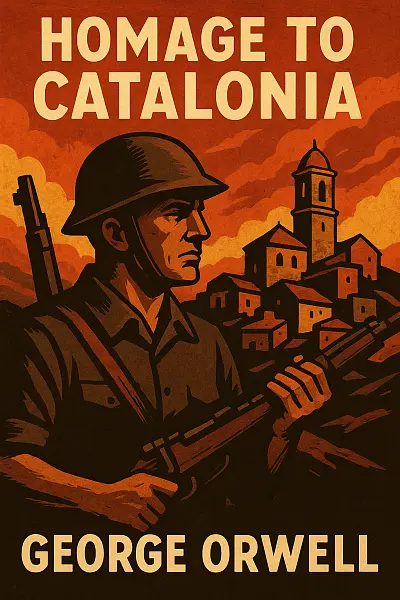
Homage to Catalonia
by: George Orwell
George Orwell arrives in war-torn Spain in 1936, eager to stand against Fascism and report firsthand on the Spanish Civil War. Thrust into the chaos of Barcelona’s front lines, Orwell’s ideals are quickly challenged as he joins a ragtag militia, hoping to make a real difference.
But everything shifts when he encounters infighting among the very leftist factions meant to be allies. Suspicion festers, and Orwell’s commitment is tested by betrayal, confusion, and ever-present danger.
He trudges through muddy trenches and tangled politics, driven by a desperate search for truth and solidarity. Written in Orwell’s sharp, honest style, the memoir immerses you in the uncertainty—will conviction or disillusionment win out?
""In the haze of revolution, truth is often the first casualty, yet it is the only banner worth raising.""
Let's Break This Down
The Author's Voice
Atmosphere:
Step into the gritty, mud-caked trenches and chaotic streets of civil war Spain. Orwell conjures a world that feels raw, immediate, and absolutely brimming with tension. There’s a sharp sense of disarray, danger lurking just out of sight, and yet—softened by moments of camaraderie and dark humor. The setting hums with authenticity; expect smoky barracks, echoing gunshots, and desperate hope all swirling together in a fog of uncertainty.
Prose Style:
Orwell’s voice is unvarnished, lucid, and downright punchy. He doesn’t waste words—his sentences are lean, direct, and conversational, almost as if he’s grabbing you by the collar and pulling you into the story. There’s a fierce honesty here, with vivid details that pop but never feel self-indulgent. Don’t expect lyrical flourishes or dramatic embellishments; instead, Orwell delivers sharp, wry observations and crisp, clear-eyed reporting.
Pacing:
The rhythm of the book is a bit of a rollercoaster—moments of electric action give way to stretches of slow, almost mundane routine. Orwell mirrors the unpredictable reality of war: tense battles and chaotic skirmishes erupt, only to dissolve into boredom, frustration, or political wrangling. The pace can feel uneven, but it’s always purposeful, capturing the ebb and flow of real life on the frontlines.
Character Portrayal:
Though this is nonfiction, the people Orwell encounters leap off the page, sketched with empathy and just enough sharpness to make them memorable. He’s terrific at zeroing in on quirks and contradictions, and—without ever feeling melodramatic—he draws out the passion, confusion, and quiet courage of ordinary fighters.
Tone and Mood:
An unexpected mix of cynicism and conviction runs through every page. There’s a restless energy, mingled with occasional disgust and disappointment, but also a stubborn sense of idealism. The mood shifts: from bleak, rain-soaked nights to rare flashes of dry wit and hope. It’ll leave you both rattled and oddly inspired.
Thematic Undercurrents:
At its core, the writing wrestles with truth, propaganda, and the failures of ideology. Orwell’s probing, skeptical tone challenges easy answers, and he’s never afraid to call out uncomfortable realities—even when it means questioning his own side. Expect searching, provocative commentary threaded seamlessly into the fabric of his personal narrative.
Overall Feel:
If you want a brutally honest, unsentimental, and surprisingly intimate look at war—delivered in prose that’s clear as spring water and as sharp as broken glass—Homage to Catalonia delivers. Orwell’s style is straight-talking, immersive, and utterly absorbing, perfect for readers who love witness accounts laced with insight and literary bite.
Key Moments
- Trenches thick with mud, misery, and Orwell’s bone-deep exhaustion—every bullet whistling with disillusionment
- First taste of revolution: Barcelona crackling with anarchist energy, red flags fluttering above cafes and barricades
- Sudden betrayal in the night—fellow revolutionaries turning guns on each other, trust splintering along ideological lines
- Orwell’s blunt, sardonic prose—dry wit cuts through propaganda and fog of war like a bayonet
- Desperate, chaotic street-fighting, loyalty tested as shifting alliances threaten everything they’re fighting for
- Haunting, understated account of a sniper’s wound—personal pain mirroring a fractured cause
- A scathing critique of political infighting, where ideals wither under suspicion and paranoia
Plot Summary
Homage to Catalonia follows George Orwell’s firsthand account of his experiences as a volunteer fighter in the Spanish Civil War. Arriving in Barcelona, Orwell joins the POUM militia and is quickly thrust into the chaos of war, witnessing both the camaraderie and disarray among anti-fascist forces. Major plot points include Orwell’s time in the trenches near Huesca, involvement in the internecine street fighting in Barcelona between rival leftist factions, and the mounting paranoia and political infighting that eclipse the struggle against the fascists. The narrative climaxes with Orwell being wounded by a sniper, surviving, and then returning to Barcelona to find POUM leaders arrested and the party suppressed, forcing him and his wife to flee Spain under threat. The book closes with Orwell reflecting on the crushing of revolutionary ideals and the grim reality of betrayal, censorship, and propaganda he witnessed.
Character Analysis
Orwell himself is both protagonist and observer—at first driven by idealistic fervor to combat fascism, but his idealism is repeatedly tested by the internal divisions, confusion, and bureaucratic betrayals he encounters. While Orwell demonstrates loyalty and empathy for his fellow soldiers regardless of political leanings, his disillusionment with the leftist movement’s fragmentation grows steadily, shifting from naive idealism to a far more skeptical, somber worldview. Key secondary figures, such as Orwell’s comrades in the POUM militia, are often sketched through brief but vivid vignettes, illuminating a shared sense of purpose and suffering rather than deep personal transformation. The character of the war itself—chaotic, muddy, and morally fraught—comes to act as a kind of antagonist, shaping and ultimately tempering Orwell’s political convictions.
Major Themes
The betrayal of revolutionary ideals stands front and center: Orwell grapples with the heartbreaking contrast between the hopeful, egalitarian spirit of Barcelona at the war’s outset and the deadly infighting that eventually undermines the anti-fascist cause. Political manipulation and propaganda emerge as powerful forces, as Orwell documents the deliberate distortion of truth by both sides to serve competing narratives; his direct exposure to “fake news” and scapegoating is a central revelation of the memoir. The nature of war itself—as dirty, confusing, and as often marked by boredom as by heroism—demystifies both battle and revolution, driving home the human cost of ideological conflict. Throughout, Orwell explores solidarity and alienation, honoring the courage of ordinary people even as he laments their exploitation by broader political machinations.
Literary Techniques & Style
Orwell’s style is famously clear, unadorned, and direct—he favors honest reportage over literary flourish, though moments of dry wit and keen observation shine throughout. The memoir structure mixes personal anecdotes, vivid battlefield descriptions, and retrospective analysis, occasionally breaking narrative flow for detailed political commentary. Orwell’s frequent use of irony and understated humor offsets the grim subject matter (his portrayal of the “romantic” revolution versus muddy trench reality is particularly potent). Symbolism is subtle but present: images of mud, squalor, and cold recur, mirroring the degradation of revolutionary hopes and the physical exhaustion that defines the soldiers’ experience.
Historical/Cultural Context
Set during the Spanish Civil War (1936–1939), Homage to Catalonia immerses readers in the ideological struggle between fascists and a fragile coalition of republicans, anarchists, socialists, and communists. Orwell’s account is steeped in the political complexity of the era, particularly the tensions between revolutionary socialism and Soviet-backed communism, which led to deadly infighting within the anti-fascist camp. Broader European anxieties about fascism, the rise of totalitarianism, and the disappointments of leftist movements deeply inform the book’s perspective.
Critical Significance & Impact
Although Homage to Catalonia was largely overlooked at publication, it’s now hailed as a classic of war literature and an essential eyewitness account of the Spanish Civil War. Orwell’s nuanced, candid exposure of the corruption and failures of both sides gives the book enduring relevance, especially in discussions of revolutionary politics and the manipulation of truth. Its tough-minded skepticism and frank examination of ideology’s limits have influenced countless readers, solidifying Orwell’s standing as a writer deeply committed to both honesty and justice.
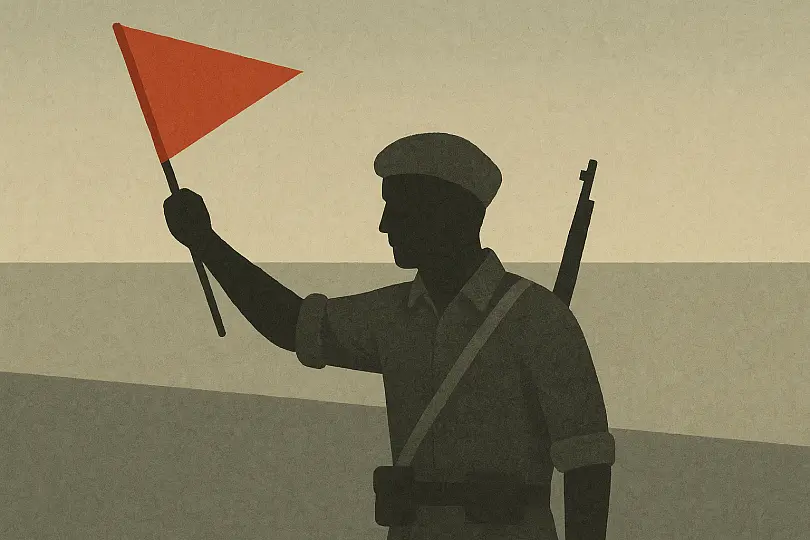
Idealism clashes with reality in Orwell’s vivid Spanish Civil War memoir
What Readers Are Saying
Right for You If
If you’re even a little bit curious about history—especially the gritty, confusing mess of the Spanish Civil War—then Homage to Catalonia is honestly a gem. You’ll love it if you’re into real-life stories that don’t sugarcoat anything, or if you’re a fan of war memoirs and want something that doesn’t just glorify battle but really digs into the politics, messiness, and everyday chaos.
Love George Orwell? This is him at his most raw and personal. The guy who wrote 1984 and Animal Farm is right there in the trenches, and his voice is sharp, honest, sometimes even darkly funny. If you’re into political writing, anti-fascism, or have a soft spot for underdog revolutions, this is definitely up your alley.
But here’s the thing: if you want a novel with big twists, pulse-pounding action, or a cozy story to escape into, this won’t do it for you. Orwell’s not shy about getting into the weeds of leftist politics—he names groups, splinters, betrayals—it can get pretty dense. If you prefer your history served neat and tidy, you might find yourself slogging through some chapters.
Also, just as a heads up for casual readers: the style is more old-school (it was published in 1938), so the language isn’t exactly breezy, and now and then you might need to pause and double-check a reference.
You’ll probably vibe with this book if:
- You dig firsthand history and memoirs from the front lines
- You’re fascinated by European politics, revolutions, or the 1930s
- You love Orwell’s style and don’t mind some heavy political discussion
- Nonfiction with an opinionated, eye-witness touch is your thing
You might want to give it a pass if:
- You’re looking for light reads, romance, or high-drama stories
- Dense political talk or war accounts just aren’t your thing
- You like everything spelled out and don’t want to Google historical details
Bottom line: If you want to jump into the thick of history with someone who was actually there, this book is totally worth your time. But if that doesn’t sound like your scene, you probably won’t miss much by skipping it.
What You're Getting Into
Set against the chaotic backdrop of the Spanish Civil War, Homage to Catalonia follows George Orwell as he dives headfirst into the realities of a conflict that’s as confusing as it is inspiring.
Orwell’s journey from idealistic volunteer to battle-hardened observer brings readers right into the heart of revolutionary Spain, unraveling the swirling alliances, betrayals, and passionate dreams that drive both the frontlines and those behind the scenes.
You’ll come away feeling like you’ve walked the gritty streets and dodged bullets with Orwell himself, all while pondering what it truly means to fight for your beliefs in a world that rarely fits simple black-and-white narratives.
Characters You'll Meet
-
George Orwell: Narrator and memoirist, Orwell shares his firsthand experiences fighting with the POUM militia in the Spanish Civil War. Deeply observant and principled, his journey is shaped by disillusionment and a search for truth in chaotic times.
-
Kopp: Orwell’s respected commander in the POUM, Kopp is pragmatic, resourceful, and courageous, often risking his own safety for his men. His eventual arrest marks a turning point in Orwell’s perspective on the internal politics of the war.
-
Georges Kopp: A charismatic Belgian officer who becomes Orwell’s close friend and mentor at the front. Kopp’s leadership and resilience stand out against the confusion and danger, highlighting both the camaraderie and tragedies of the conflict.
-
Orwell’s Wife (Eileen Blair): Although mainly a presence in the background, Eileen provides emotional support and stability for Orwell, especially during the dangerous and chaotic aftermath in Barcelona.
-
Italian Militiaman: A symbol rather than a fully developed character, this nameless fighter embodies the idealistic spirit and international solidarity that initially attract Orwell to the republican cause, leaving a lasting impression on his worldview.
More Like This
If you found the personal immediacy and raw honesty of All Quiet on the Western Front compelling, you’ll likely be riveted by Homage to Catalonia—Orwell’s firsthand observations cut through ideology to lay bare the disarray, fear, and unexpected camaraderie of soldiers caught in political chaos, much like Remarque’s portrayal of World War I’s grim truths. There’s also a striking kinship with Hemingway’s For Whom the Bell Tolls; both works plunge readers into the Spanish Civil War’s muddy trenches and murky loyalties, but where Hemingway filters experience through fiction and romance, Orwell delivers sharply observed reportage that still manages to capture the idealism and disillusionment of the age.
On the screen, Homage to Catalonia resonates with the gritty realism of the series Generation Kill, which tracks a group of Marines through the confusion and contradiction of modern warfare. Both Orwell and the creators of Generation Kill expose how propaganda, shifting allegiances, and the harshness of daily combat shape the perspectives—and often erode the innocence—of those on the front lines, giving readers and viewers alike a bracingly authentic sense of what it feels like to live history as it unfolds.
Critic's Corner
What does it mean to see history unfold—and then discover you’ve misunderstood it?
Homage to Catalonia raises the unsettling question of whether any political conviction, no matter how passionate or well-intentioned, can survive the chaos of real war. Orwell doesn’t simply bear witness; he interrogates reality itself, wrestling with the unreliability of memory, propaganda, and personal certainty. This book demands, with urgent intimacy: Whose truth survives, and at what cost to our ideals?
Orwell’s prose is famously clear, but here it’s sharpened by lived danger and skepticism. Each page brims with directness—no heavy ornamentation, no sentimentality. His narrative style blends memoir and reportage, creating a disarming sense of “being there.” When Orwell describes the cold, his discomfort is physical, not theoretical; when confusion erupts on the Barcelona front, his bewilderment feels raw and immediate. There’s a methodical attention to daily details—mud, missed rations, the rhythm of minor mishaps—that grounds the narrative in lived reality. Yet Orwell’s digressions into political analysis are never dry: he sneaks in sharp, ironic humor (“The kind of bullets flying around seemed to obey the rules of incompetence more than ideology”) and wields understatement with surgical precision. The language—spare, precise, at times mordantly witty—offers little comfort but ample illumination. It’s a risky, intimate kind of storytelling that never lets the reader look away.
At its heart, the book is a meditation on betrayal—both political and personal. Orwell draws the reader into the exhilarating surge of collectivist hope, only to reveal the grim fragmentation within the anti-fascist factions. Idealism slowly curdles into suspicion—the enemy is not just across the trenches, but beside you in the barracks. The moral ambiguity underpinning revolutionary conflict—who are the true revolutionaries, and do “sides” even matter when truth itself is malleable—feels as urgent now as it did in the 1930s. In a world of social media spin, “fake news,” and ideological polarization, Orwell’s skepticism about righteousness and narrative control lands with eerie resonance. The book’s real philosophical question lingers: Can faith in justice survive the compromises violence requires? For contemporary readers, watching Orwell’s disillusionment unfold is not just instructive—it’s emotionally bracing, a warning shot across the history books.
Within the vast tradition of war literature, Homage to Catalonia is an odd, essential hybrid: part journalism, part personal testimony, part subtle political polemic. It’s rawer than Hemingway’s Spanish Civil War fiction and more confessional than most histories. Among Orwell’s own works, it stands as a deeply personal prelude to the ideological nightmares of Animal Farm and 1984. Where those books offer allegory, Homage offers lived paradox—making it foundational for understanding Orwell’s oeuvre and the ongoing relevance of witness literature.
Homage to Catalonia is not flawless. Orwell’s political reflections, essential as they are, can bog down the narrative momentum, and his perspective—honest but limited—leaves crucial gaps. Yet its haunting candor, literary clarity, and enduring skepticism make it not only a crucial firsthand account, but a bracing antidote to simplistic versions of history. You come away unsettled, and that’s the point.
Community Thoughts
that opening scene in the trenches where the cold seeps into every line stuck with me for days, couldn't shake the feeling that I was right there, shivering and uncertain, just like orwell was.
I can’t shake the image of Orwell freezing in those trenches, cigarettes running low, watching the lines blur between friend and enemy. That stubborn hope of his clings to you long after you close the book.
Not gonna lie, that scene where Orwell realizes the factions he’s fighting for are turning on each other? That was the moment my brain did cartwheels. Everything changed and suddenly nothing felt heroic anymore.
I couldn’t get that trench scene out of my head, the mud and chaos felt too real. Orwell’s raw account just lingers, making you question what side you’d be on if pushed.
orwell’s descriptions of barcelona at night got stuck in my head, making me double-check my windows before bed. his insomnia became my own for a week.
Leave Your Review
Local Take
Why It Matters
Homage to Catalonia by George Orwell strikes a surprisingly personal chord with readers here in Spain—it’s like holding up a mirror to the country’s own past and present.
- The book’s exploration of fractured loyalties and political infighting connects directly with the memory of Spain’s Civil War and its lingering aftershocks. For many Spaniards, Orwell’s honest, sometimes brutal take on the war echoes family stories and old neighborhood legends.
- Themes of idealism clashing with harsh reality—so central to Spanish history—resonate deeply in a culture that still debates the meaning of the Civil War, dictatorship, and transitions to democracy.
- The story’s disillusionment with political factions reminds readers of both past divisions and current polarization here.
- Orwell’s blunt, unromantic prose contrasts with Spain’s tradition of poetic civil war literature, but that makes his truth-telling hit even harder.
In short, Homage to Catalonia isn’t just a foreigner’s snapshot; for many in Spain, it’s uncomfortably close to home.
Food for Thought
-
Homage to Catalonia has sparked controversy due to Orwell's critical portrayal of Communist factions during the Spanish Civil War, leading to debates over the book’s accuracy and accusations of political bias, especially from those sympathetic to different ideological perspectives.
-
Some critics have challenged Orwell’s personal observations, suggesting they are subjective and limited, fueling enduring cultural debates about the complexity and representation of the Spanish conflict.
Like what you see? Share it with other readers